GDPR for Wearable Technology: Compliance Guide
Updated: July 2026
The General Data Protection Regulation (GDPR) applies to all wearable devices that collect personal data of individuals in the EU. Health and fitness data from smartwatches, fitness trackers, and health monitors are classified as sensitive health data under Article 9. This classification requires the highest level of data protection and explicit consent for processing.
Enacted by the European Union in 2018, this comprehensive legal framework sets stringent privacy rules. These rules affect how companies handle biometric data, sleep patterns, heart rate measurements, and other continuous health metrics collected from users’ bodies.
This guide focuses on the specific legal requirements for GDPR compliance in wearable technology.
Whether you develop fitness tracking apps, manufacture medical devices, or implement workplace wellness programmes, understanding these regulations is essential. Failure to comply can lead to penalties of up to 4% of annual turnover or €20 million, whichever is higher.
Key Takeaways
Here are the most essential points to understand about GDPR and wearable technology:
• Certain wearable data may qualify as special category health data under GDPR Article 9, requiring explicit consent and stronger protection.
• Data minimisation principles limit data collection to only what is necessary for stated purposes.
• The always-on nature of wearables poses challenges by increasing the risk of over-collection and data breaches.
• Cross-border data transfers to non-EU servers require Standard Contractual Clauses and extra safeguards.
• Health-related data demands the most stringent security and transparent data practices.
What is GDPR’s scope for wearable technology?
What is wearable technology under GDPR?
Wearable technology includes any body-worn device that processes personal data of natural persons. Examples include:
• Smartwatches
• Fitness trackers
• Health monitors
• Smart clothing
• Connected medical devices
These devices collect various types of data, such as:
• Biometric data
• Activity data
• Location tracking information
• Health status indicators
The GDPR applies regardless of the manufacturer’s location, as long as the device processes data of individuals in the EU or monitors behaviour within the EU.
Why does GDPR matter for wearables?
Since 2018, GDPR transformed voluntary data protection into mandatory compliance. The always-on nature of wearables means they continuously collect sensitive information about users’ health, location, and behaviour. Often, users are unaware of ongoing data processing.
This constant data flow raises unique privacy concerns that manufacturers must address.
How is health data classified for wearables under GDPR?
What counts as health data?
GDPR Article 9 defines health data as any information concerning the physical or mental health status of a natural person. This includes data revealing a person’s health condition.
For wearables, this definition encompasses far more than just obvious medical data. Even seemingly harmless data points can reveal health insights when combined or analysed over time.
How do you assess whether wearable data qualifies as health data?
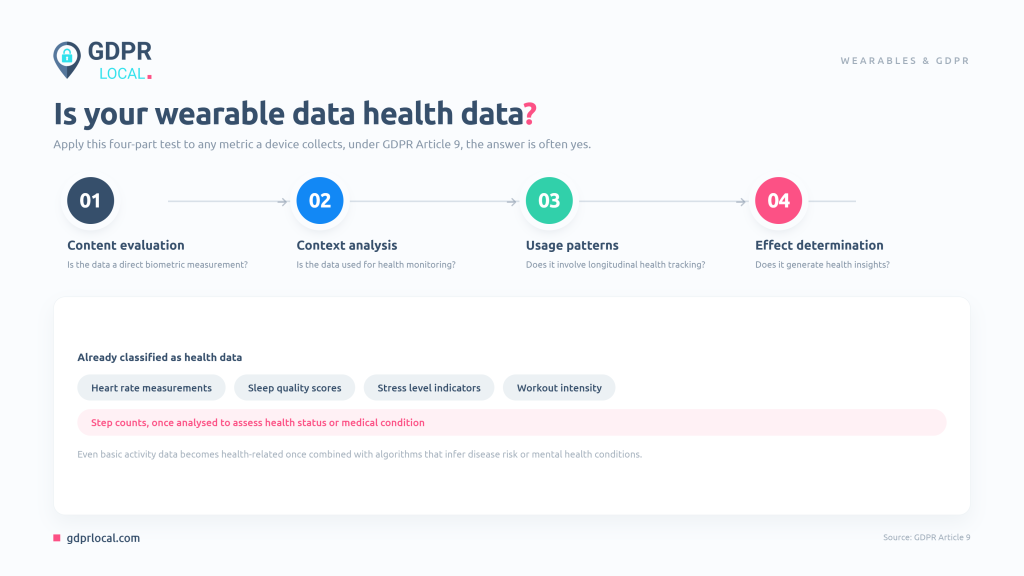
To determine if wearable data is sensitive health data, apply this model:
1. Content Evaluation: Are the data direct biometric measurements?
2. Context Analysis: Is the data used for health monitoring?
3. Usage Patterns: Does it involve longitudinal health tracking?
4. Effect Determination: Does it generate health insights?
Examples of data classified as health data include:
• Heart rate measurements
• Sleep quality scores
• Stress level indicators
• Step counts may become health data when analysed to assess a person’s health condition or medical status
• Workout intensity data
Even basic activity data can become health-related when combined with algorithms to infer disease risks or mental health conditions.
This broad interpretation reflects the EU’s recognition that wearables reveal intimate health details through sophisticated data processing.
What is the difference between personal data and health data in wearables?
What are the key differences between personal data and health data?
• Personal data: Includes device preferences, contact info synced from smartphones, user profiles, and basic location info.
• Health data: Includes biometric measurements, medical device readings, fitness metrics, and any data revealing health status or physical condition.
Why does the distinction between data types matter?
Health data requires explicit consent under Article 9. Other personal data may be processed under the legal bases set out in Article 6.
Mixed data scenarios can complicate compliance, such as:
• Combining step counts with location tracking to infer health conditions.
• Analysing sleep patterns and heart rate variability to generate wellness recommendations.
Such combinations transform basic activity monitoring into health data processing, triggering stricter legal requirements.
Understanding these categories guides:
• The protective measures to apply
• Consent mechanisms to implement
• User rights to uphold
This classification determines what data security and processing standards apply.
What are the GDPR compliance requirements for wearables?
What is the legal basis for processing wearable data?
Article 6 lists six lawful bases for processing personal data:
• Consent
• Contract performance
• Legal obligation
• Vital interests
• Public task
• Legitimate interests
Article 9 adds conditions for processing sensitive health data:
• Primarily requires explicit consent
• Allows processing for medical purposes, public health, or scientific research with safeguards
For most commercial wearables, explicit consent is the primary legal basis.
What are the requirements for explicit consent?
Consent must be:
• Freely given
• Specific to processing purposes
• Informed about data usage
• Unambiguous with clear affirmative action
Challenges include:
• Bundled consent in lengthy terms and conditions
• Ensuring users understand continuous health monitoring
• Allowing easy withdrawal without breaking non-health device functions
When can legitimate interests apply to wearable data?
Legitimate interests cannot justify processing Article 9 health data.
It may apply to basic device functions, such as software updates or security measures, but not to secondary uses, such as targeted advertising or third-party sharing without consent.
What does data protection by design and default require for wearables?
What does data protection by design mean in practice?
Article 25 mandates the integration of privacy safeguards into wearable technology from design to deployment.
Key principles:
• Default settings process only the necessary personal data.
• Privacy is built into every stage of product development.
What technical measures should wearables implement?
Examples include:
• Encryption in transit and at rest
• Pseudonymisation of health metrics
• Secure data transmission protocols
• On-device processing to reduce cloud storage
Default privacy settings should:
• Automatically minimise data collection
• Provide granular consent options
• Implement automatic data retention matched to stated purposes
When are DPIAs required for wearable technology?
Required under Article 35 for high-risk processing, such as:
• Advanced health monitoring
• Systematic location tracking
• Large-scale health data profiling
DPIAs help evaluate risks and implement proportional safeguards.
What user rights apply to wearable data?
Under Articles 15-22, data subjects have rights, including:
• Access: Obtain a copy of personal data and information about how it is processed
• Rectification: Correct inaccurate health data or algorithmic interpretations
• Erasure: Delete data when purposes are fulfilled
• Portability: Transfer fitness and health data between platforms
What challenges arise when implementing user rights for wearables?
• Correcting algorithmic health assessments can be complex.
• Data portability may be limited by incompatible formats or closed algorithms.
User-friendly interfaces must enable meaningful control over personal data.
How does consent compare with legitimate interest for wearable data?
| Feature | Explicit Consent | Legitimate Interest |
|---|---|---|
| Health Data Processing | Required for Article 9 data | Not allowed for health data |
| User Control | Easy withdrawal required | Opt-out rights with a balancing test |
| Processing Scope | Limited to consented purposes | Must pass the necessity and proportionality test |
| Withdrawal Impact | Cannot affect other device functions | May impact core service delivery |
| Documentation | Proof of valid consent collection | Legitimate interest assessment required |
| Risk Level | Lower risk if implemented properly | Higher scrutiny in data subject balancing |
For wearable technology, health data processing almost always requires explicit consent. Exceptions include medical treatment, public health, or scientific research with oversight.
Basic device functions, such as software updates, may rely on legitimate interests, but health data analysis requires stronger consent frameworks.
What are the common GDPR compliance challenges for wearables?
How do wearable manufacturers obtain valid consent?
• Implement granular consent with clear explanations of data use.
• Provide regular renewal prompts.
• Offer easy withdrawal options.
• Address consent fatigue from complex privacy policies.
• Balance continuous health monitoring with comprehensive consent.
How should wearables handle cross-border data transfers?
• Use Standard Contractual Clauses (SCCs) or adequacy decisions.
• Apply supplementary measures for sensitive health data.
• Strengthen protections with end-to-end encryption and access controls.
• Conduct transfer impact assessments.
• Consider data localisation within EU regions.
How should wearables manage third-party data sharing?
• Establish clear data processing agreements with app developers.
• Implement API access controls for granular permissions.
• Provide transparency about data sharing.
• Allow users to control disclosures to third parties.
• Manage complex data controller relationships across platforms.
Conclusion
GDPR compliance for wearable technology requires recognising that most fitness and health data are sensitive health data under Article 9. This demands:
• Explicit consent
• Stronger security measures
• Full user rights implementation beyond standard data protection
The regulation’s broad interpretation of health data means even basic activity tracking often requires the highest level of privacy protection when processed continuously or combined with other data.
Successful compliance balances innovation with ethical data practices. It requires a user-centric design that provides meaningful privacy controls without compromising health monitoring functionality.
As wearable technology evolves toward sophisticated health insights and medical applications, ongoing attention to data minimisation, purpose limitation, and user autonomy remains essential.
The integration of emerging technologies such as artificial intelligence and telemedicine will further challenge privacy protections, requiring vigilant regulatory adaptation in an era of ubiquitous health monitoring.
Frequently Asked Questions
Do smartwatches and fitness trackers need explicit GDPR consent?
Yes, in most cases. Where a wearable collects health-related data, heart rate, sleep patterns, and stress indicators, that data falls under Article 9 as special category data and requires explicit consent. Standard consent checkboxes in terms and conditions are not sufficient. Consent must be freely given, specific to each processing purpose, and easy to withdraw without affecting the device’s non-health functions.
Is step-count data considered health data under the GDPR?
It depends on how it is used. Step count on its own may be personal data rather than health data. It crosses into health data territory when it is processed to assess fitness levels, infer a medical condition, or combined with other metrics such as heart rate or sleep data to generate health insights. Wearable manufacturers should apply the four-step assessment: content, context, usage pattern, and effect, to determine which category it falls under before choosing a legal basis for processing.
Does GDPR apply to wearable companies based outside the EU?
Yes. GDPR applies to any organisation that processes the personal data of individuals in the EU, regardless of where the company is based. A fitness tracker manufacturer headquartered in the United States or Asia still needs to comply if their devices are used by people in the EU. This includes appointing an EU representative under Article 27, implementing Standard Contractual Clauses for data transfers, and meeting all consent and security requirements.
Can employers use wearables to monitor workers under GDPR?
Only under strict conditions. Workplace wellness programmes that use wearables involve continuous health monitoring of employees, which constitutes high-risk processing under the GDPR. Employers generally cannot rely on employee consent as a freely given legal basis due to the power imbalance in the employment relationship. Processing would need a stronger legal basis, a Data Protection Impact Assessment, and clear necessity. Covert or blanket biometric monitoring of staff is unlikely to be lawful.

About the Author
Zlatko Delev
Country Manager & Head of Commercial — GDPRLocal
Zlatko specialises in data protection compliance, ISMS strategy, and AI law. With a legal background and hands-on experience supporting organisations globally, he helps businesses navigate GDPR, the EU AI Act, and international privacy frameworks.

About the Author
Head of Commercial & Country Manager
Zlatko Delev is Head of Commercial and Country Manager at GDPRLocal, where he leads the company’s commercial strategy and market presence. He brings international experience across sales, marketing, and customer success, along with a legal background from his studies at Iustinianus Primus Law School in Skopje, Macedonia.
Zlatko sits at the front line of GDPRLocal’s client relationships, guiding organisations through the first stages of their compliance journey and helping them understand where they stand and where they need to go on GDPR, information security, and the emerging landscape of AI regulation. His role bridges commercial strategy with practical data protection knowledge, ensuring clients get clear, actionable direction from their very first conversation with GDPRLocal.
Alongside his commercial focus, Zlatko has trained extensively in project management and organisational leadership, including risk management, stakeholder communication, agile methodology, and digital marketing, a broad skill set that supports his structured, delivery-focused approach to growing GDPRLocal’s business internationally.