Guide to Data Protection Officer (DPO) Services
Ask most business owners whether they need a Data Protection Officer, and the answer is no. It sounds like a rule for banks and hospitals, not for a company like theirs. That assumption is wrong, and that mistake is expensive.
GDPR fines have now passed €7 billion, with around €1.2 billion issued in 2025 alone. Regulators are handing down penalties at that scale year after year.
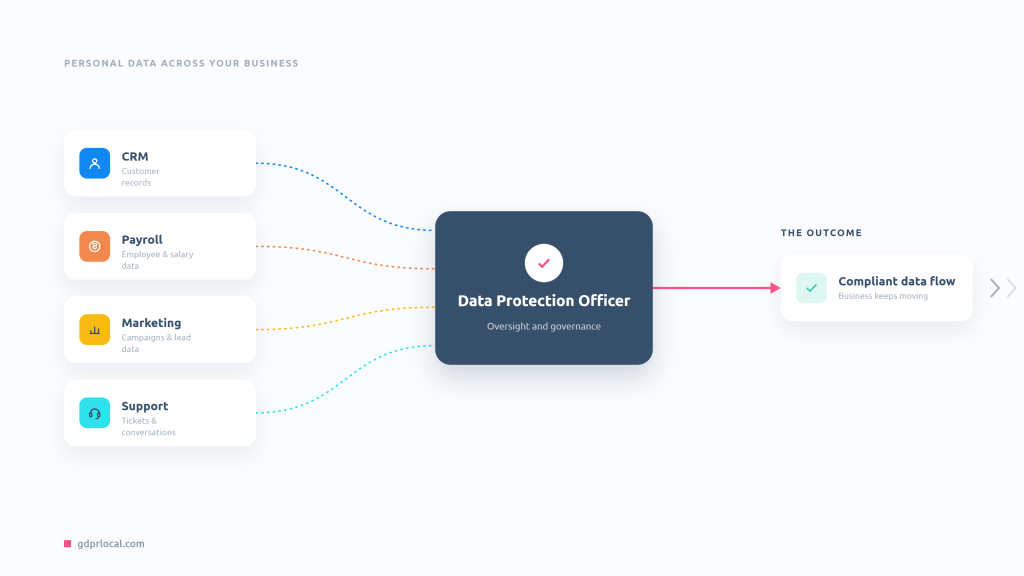
Personal data now moves through almost every part of a modern business: your CRM, your payroll, your marketing tools, your customer support inbox. All of it useful. All of it risky. One weak process or one late notification can trigger an investigation, a heavy fine, and years of lost trust. Under the GDPR, the worst breaches can cost up to 20 million euros. For companies with very high turnover, that cap rises to 4% of global annual revenue.
A Data Protection Officer (DPO) is how you keep those risks under control. A good DPO gives straight advice, catches problems while they are still cheap to fix, and keeps your data practices in step with the law so the business can keep moving.
This guide sets out what a DPO does, when the law says you must have one, and how the right setup protects your business without holding it back. It compares hiring in-house with an outsourced service, and shows how GDPRLocal builds a data protection framework based on how your business works.
Key Takeaways
• What a DPO does: informs, advises, and monitors your compliance with data protection law, in a role defined by Articles 37 to 39 of the GDPR.
• When one is mandatory: you must appoint a DPO in three specific cases, though many businesses appoint one voluntarily for practical reasons.
• Independence is essential: a DPO cannot be told how to reach their conclusions and cannot be penalised for doing the job properly.
• Outsourcing is allowed: the GDPR lets a DPO be an employee or an external service provider, which makes the DPO-as-a-Service model a valid and often cheaper option.
• UK law still requires it: the Data (Use and Access) Act 2025 amended data protection law, but the requirement to designate a DPO under Article 37 remains in force.
• What a full service covers: advice on new projects, DPIAs to vendor review, staff training, breach response inside the 72-hour deadline, and ongoing monitoring.
• Ecosystem framing: protection holds together best when a DPO is paired with EU and UK representation and the right software, so records, data requests, and regulator contact run through one coordinated setup.
• Approach framing: GDPRLocal builds each framework in four phases: mapping your data, setting governance rules, training staff, then monitoring and adapting as laws and risks change.
What Is a Data Protection Officer (DPO) and Why Does GDPR Require One?
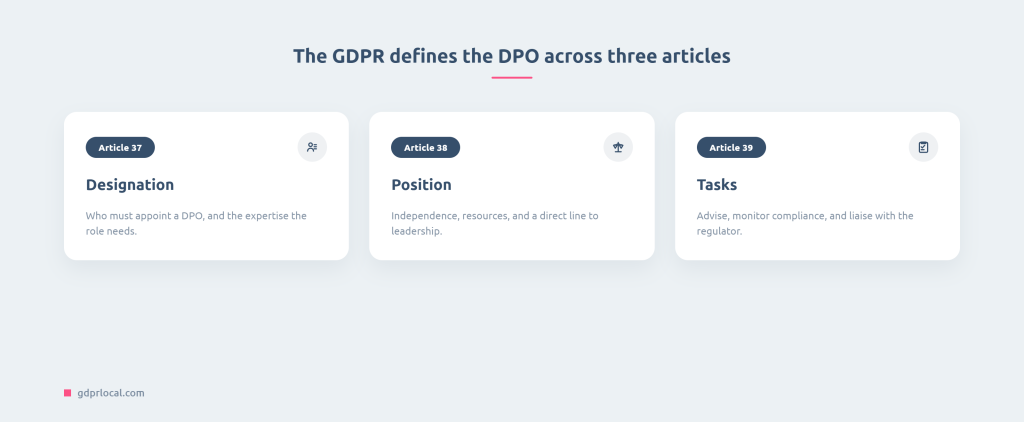
A Data Protection Officer is the person responsible for overseeing how an organisation handles personal data. The role is a defined position in the GDPR, and its scope is set out across articles 37, 38, and 39.
Article 37 covers designation. It sets out who must appoint a DPO and what qualities that person needs. A DPO must be chosen based on professional expertise and knowledge of data protection laws and practice. The same article confirms that a group of companies may share a single DPO, and that the role can be filled by an employee or by an external provider working under a service contract. That last point is the legal basis for the outsourced, DPO-as-a-Service model.
Article 38 covers position. It protects the DPO’s ability to do the job well. The organisation must involve the DPO in all data protection matters in good time, provide the resources and access they need, and allow them to report to the highest level of management. It also states that the DPO cannot be dismissed or penalised for carrying out their tasks, and that they must be free of any conflict of interest.
Article 39 covers tasks. It lists the core duties: to inform and advise the organisation and its staff, to monitor compliance with the law and with internal policies, to advise on Data Protection Impact Assessments, and to act as the contact point for the supervisory authority.
At first, this level of oversight looks like it would slow a business down. In practice, the opposite happens. A Data Protection Officer (DPO) who is involved early can flag issues while a product is still being designed, when changes are cheap and quick to make. That is easier than pausing a launch or unwinding a live feature after a regulator raises a concern.
When Do You Need Data Protection Officer Services?
There are two questions here.
The first is a legal question: does the law require you to appoint a DPO? For some organisations, the answer is yes, and they have no choice.
The second is a commercial question: even if the law does not require it, would a DPO service still be a reasonable investment? For many businesses, the answer is also yes.
Companies fall into one of three groups. Some are legally required to appoint a DPO and must act. Some are not required to, but handle enough personal data that professional support pays for itself. And some process very little personal data and can manage with lighter, occasional advice. The sections below help you work out which group fits your business.
When a DPO Is Mandatory
The GDPR names three situations where appointing a DPO is not optional. If any one of them applies to you, you must appoint one.
1. Public authorities and public bodies. Any organisation that carries out a public function must appoint a Data Protection Officer. The only exception is courts acting in their judicial capacity.
2. Large-scale regular monitoring. You must appoint a DPO if your core activities involve regular and systematic monitoring of individuals on a large scale. This covers businesses whose main work depends on tracking behaviour, such as advertising networks, location-tracking services, and platforms that profile users at scale.
3. Large-scale processing of sensitive data. You must appoint a Data Protection Officer if your core activities involve large-scale processing of special category data or data about criminal convictions and offences. Such data includes information about health, ethnicity, religious beliefs, and biometric identifiers. Hospitals, insurers, and health-tech platforms often sit in this group.
“Core activities” refers to the processing that sits at the heart of what you do. If the processing is central to your service, and it is large in scale, the obligation is likely to apply. When your position is unclear, a short assessment can confirm your status before you commit either way.
Why Appoint a DPO Even When You Don’t Have To?
Appointing a DPO is not reserved only for organisations that are required to. The GDPR allows a voluntary appointment, and regulators such as the ICO note that a DPO helps improve accountability and strengthens an organisation’s data protection governance. Those benefits show up in day-to-day work.
The first benefit is fewer mistakes. A Data Protection Officer who reviews new projects, contracts, and marketing campaigns catches small errors before they turn into breaches or complaints. Prevention is far cheaper than damage control.
The second benefit is faster, clearer decisions. When a question about consent, retention, or an international transfer comes up, teams have an expert to turn to, which keeps projects moving.
The third benefit is trust. Customers, partners, and investors ask how you protect personal data before they commit. Being able to point to a named data protection expert, and to the framework behind them, signals that you take the responsibility seriously. In sales and funding rounds, that reassurance can tip a decision your way.
Why Must a DPO Stay Independent?
A Data Protection Officer cannot do the job properly if a manager can overrule their conclusions whenever they are inconvenient. Independence is what gives the role its value, and the GDPR protects it.
But what does independence mean in practice? A few things.
The DPO can reach their own judgement without being told what answer to give. They report to the most senior level of the organisation, so their advice is heard by the people who set direction. They cannot be dismissed or penalised for carrying out their duties, even when their advice is unwelcome. And they must be free of any conflict of interest, which is why the head of marketing or the head of IT, whose decisions the DPO reviews, usually cannot hold the role as well.
This is honest, sometimes uncomfortable advice. A DPO might tell you that a planned campaign needs a different lawful basis, or that a new vendor is not safe to use yet. An independent DPO protects the business from its own blind spots – a service you cannot buy from someone who only tells you what you want to hear.
Not sure whether you need a DPO?
Get a clear answer with a short compliance assessment from our data protection specialists.
Free assessment, no commitment required.
Check Your ObligationsWhat Does a Full DPO Service Do Day to Day?
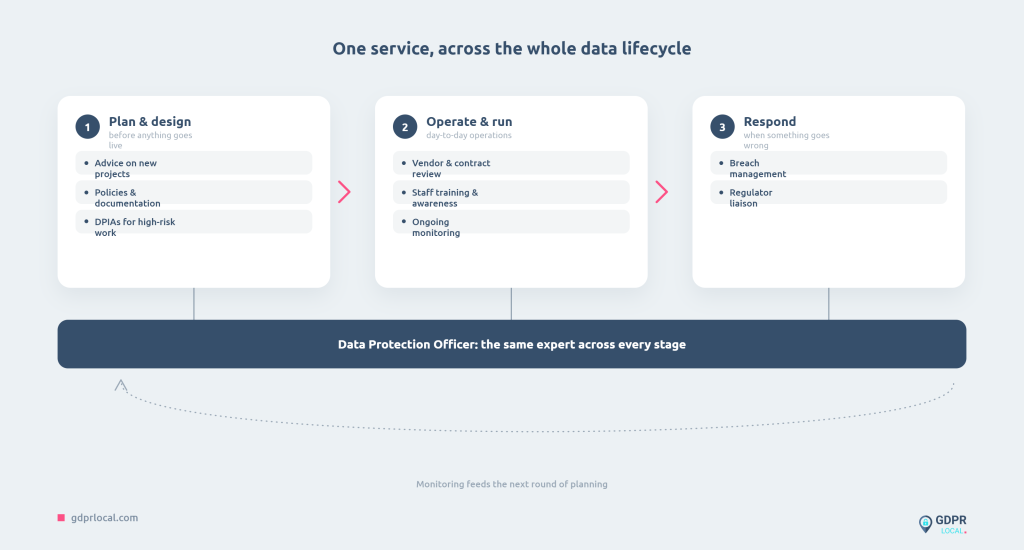
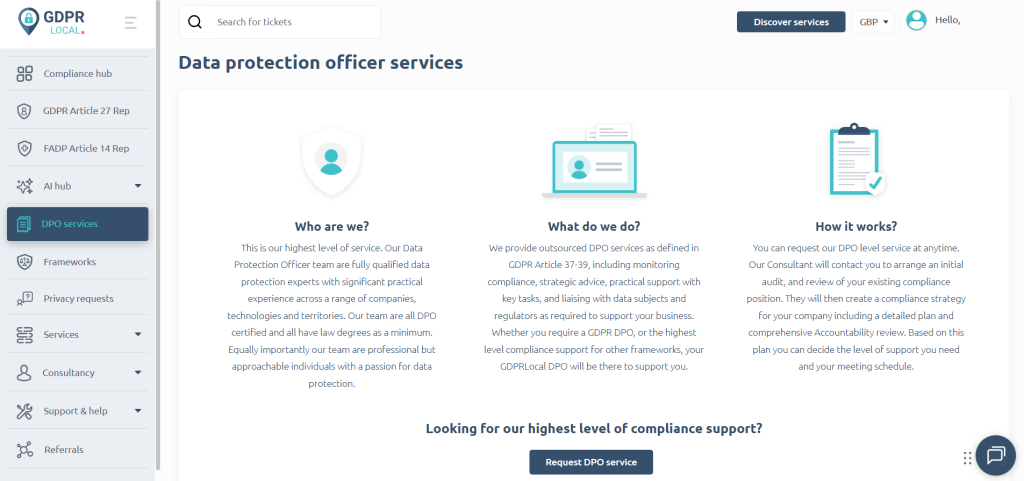
A complete DPO service supports your business across the whole lifecycle of personal data, from planning to incident response. A typical service covers:
• Advice and guidance on new projects, products, and processing activities before they go live.
• Policy and documentation, including privacy notices, retention schedules, and records of processing.
• Data Protection Impact Assessments for high-risk activities, with practical steps to reduce that risk.
• Vendor and contract review, so third-party tools do not create hidden gaps.
• Staff training and awareness, so good habits reach the whole team.
• Breach management and regulator liaison, so you have expert help ready when something goes wrong.
• Ongoing monitoring, so your framework keeps pace with new laws, tools, and risks.
Strategic Advice and Board Guidance
Some of the most important data protection decisions are made long before anything is built or launched. They are made in board meetings and planning sessions, when leaders decide to launch a new product, enter a new market, or adopt a new technology.
A DPO who sits close to leadership brings data protection into those decisions from the start. Before you build a feature that relies on user profiling, the DPO can set out what the law requires and what safeguards you will need. Before you expand into a new country, they can flag the local rules that apply. Before you sign up to a new analytics tool, they can weigh the benefits against the risks.
This guidance helps leaders make informed choices with a full view of the trade-offs. Data protection shapes strategy from the start, which almost always produces better – and cheaper – outcomes.
Third-Party and Vendor Risk Management
Very few businesses handle personal data entirely on their own. You rely on cloud hosts, payment providers, email platforms, and analytics tools. Every one of those suppliers is a point where data leaves your direct control, and every one is a place where a compliance gap can open up.
A DPO manages this risk on your behalf. They review each supplier before you onboard them, checking where data will be stored, how it will be protected, and whether the arrangement meets the standard the law expects. They make sure a proper data processing agreement is in place, so responsibilities are written down. They also monitor international transfers, since sending data outside the UK or EU brings extra conditions that are easy to overlook.
Without this oversight, a single poorly vetted tool can undermine an otherwise careful compliance program. With it, your supply chain becomes a managed risk.
Breach Management and Regulator Liaison
No matter how careful you are, incidents happen. The first hours decide whether an incident stays contained or gets out of hand. That’s where a DPO service does its most important work.
When a breach occurs, the DPO takes control of the response. They assess what happened, what data was affected, and how serious the risk to individuals is. That assessment drives all decisions that follow.
Under the GDPR, you must notify the relevant supervisory authority, such as the ICO in the UK, within 72 hours of becoming aware of a breach, where the breach is likely to result in a risk to people’s rights. If the risk to individuals is high, you may also need to tell the affected people. Missing these deadlines can turn an incident into a compliance failure with its own penalties.
A DPO manages this window on your behalf. They prepare the notification, judge whether it is required, and speak to the supervisory authority. Having an experienced professional handle that conversation keeps your response accurate, at the exact moment when a rushed or incomplete answer could make things worse.
In-House or Outsourced DPO: Which Is Right for You?
Once you decide you need a DPO, the next step is how to appoint one. You can hire an employee to fill the role, or you can appoint an external provider through a DPO-as-a-Service arrangement. Both are valid under the GDPR, and both can work well. They just serve different needs and budgets.
The right choice depends on the size of your business, the complexity of your data, and how much specialist knowledge you have in-house.
The Hidden Cost of an In-House DPO
Hiring an in-house DPO might look simple at first: one role, one salary. But the full cost is higher.
A qualified DPO commands a senior salary, because the role demands a high level of expertise. On top of that base cost, you carry the usual employment overheads – pension contributions, benefits, equipment, recruitment fees. You also need to fund ongoing training, since data protection law changes often and their knowledge has to stay current.
Then there’s the problem of cover. An in-house DPO takes holidays, falls ill, and eventually moves on. Data protection obligations do not pause when they are away. A 72-hour breach deadline does not wait for someone to return from leave. To cover these gaps, you may need a second person or an external backup, which adds cost – again.
For a large enterprise with constant, complex processing, an in-house team can be the right answer. For most small and mid-sized businesses, the full price of doing it in-house is far higher than it might seem at first.
The Benefit of an Outsourced DPO as a Critical Friend
An outsourced DPO gives you the expertise without the overheads, but the true value goes beyond cost. A good external DPO acts as a critical friend.
A critical friend is on your side and wants your business to succeed. That’s why they will also tell you the hard truths. An outsourced DPO does not depend on internal politics or fear for their position; they can give you advice without hesitation. When a plan carries too much risk, they will say so, and they will help you find a safer route than blocking the idea.
This relationship also brings experience. An external DPO works across many organisations and sectors, so they have seen a wide range of problems and solutions. They bring that pattern recognition to your business, spotting issues that an isolated in-house hire might miss. You gain a trusted adviser who challenges you when it counts and reassures you when you are on solid ground.
Want expert DPO support without the cost of a full-time hire?
Our DPO-as-a-Service gives you a qualified, independent expert on demand.
Flexible, affordable, and fully compliant.
Explore DPO ServicesIn-House vs DPO-as-a-Service: How Do They Compare?
Seeing both options side by side makes the decision easier. The table below compares them across four factors: cost, skills, cover, and independence.
| Factor | In-House DPO | DPO-as-a-Service |
| Cost | Senior salary plus pension, benefits, equipment, training, and recruitment. A fixed, ongoing overhead. | A predictable service fee, usually far lower than a full salary, with no employment overheads. |
| Skills | Limited to the knowledge and experience of one person. Depth depends on that single hire. | Access to a team with broad, cross-sector experience and current legal knowledge. |
| Cover | Gaps during holidays, illness, and staff turnover. Deadlines do not pause. | Continuous cover built in, so obligations are met even when one adviser is unavailable. |
| Independence | Can be influenced by internal reporting lines and job security concerns. | Structurally independent, which supports frank and impartial advice. |
For businesses growing quickly, the outsourced model offers stronger cover and independence at a lower and more predictable cost. Larger organisations with heavy, complex processing may still prefer an in-house team, or a combination of both.
The GDPRLocal Approach: How We Build Your Framework
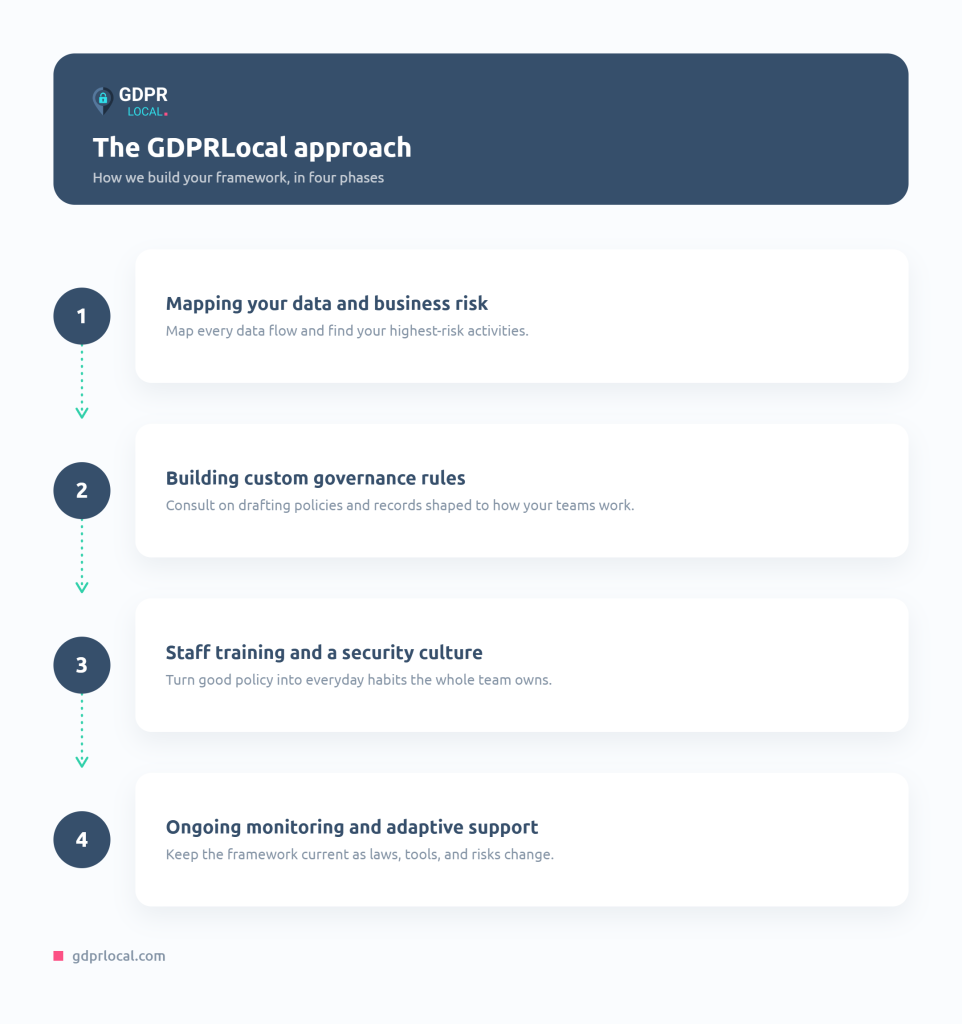
A data protection framework works best when each stage lays the ground for the next. At GDPRLocal, we build every client’s framework through four phases. This structure keeps the work in order, avoids surprises, and produces a setup that fits your business.
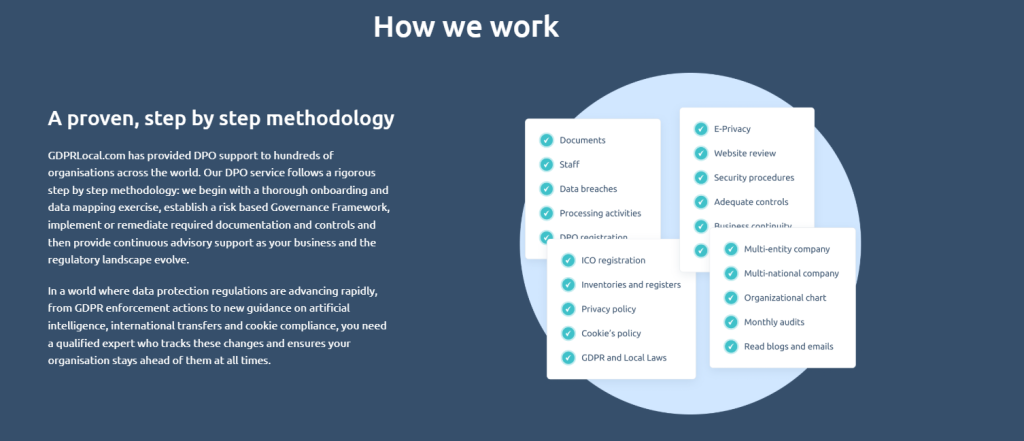
Phase 1: Mapping Your Data and Business Risk
Before we fix anything, we need to see the full picture. You cannot protect data if you do not know where it lives or how it moves.
In this first phase, we map every flow of personal data through your business. We look at what data you collect, where it comes from, where it is stored, who has access to it, and which third parties it reaches. We also identify the activities that carry the most risk, such as large-scale profiling or international transfers.
The result is a clear view of your current position. This map becomes the foundation for everything that follows. It shows where the gaps are, so the work that comes next is properly targeted.
Phase 2: Building Custom Governance Rules
No two businesses handle data in the same way. A generic template rarely matches how your teams work, and rules that do not fit tend to be ignored.
In this phase, we design governance rules and controls around your operations. We give you templates and guidance for the policies, privacy notices, retention schedules, and processing records you need, tailored to your sector, your data, and your risk profile. Where the first phase found gaps, this phase closes them with practical measures.
The goal is a set of rules your teams can follow without friction, because they were built around the way your business runs.
Phase 3: Staff Training and Building a Security Culture
Even the best-written policy fails if the people do not follow it. Most data breaches trace back to human error, so your staff are your first and most important line of defence.
In this phase, we turn good policy into good habits. We train your teams in plain language, so they understand both the rules and the reasons behind them. We focus on the everyday moments where mistakes happen, such as handling customer requests, spotting suspicious emails, and sharing data safely.
The goal is a security culture, where careful data handling is part of how people work. When good habits are shared across the whole team, compliance becomes something the whole organisation supports.
Phase 4: Ongoing Monitoring and Adaptive Support
Data protection is never finished. Laws change, your business grows, and new tools bring new risks. A framework that fits perfectly today can fall out of date within a year if no one maintains it.
This final phase keeps your setup current. We monitor changes in the law and advise on updating your policies to match. We review new projects and suppliers as they appear. And we answer questions and handle incidents as they arise.
The UK’s own recent reforms show why this matters. The Data (Use and Access) Act 2025 amended UK data protection law on a rolling basis through 2025 and 2026, changing rules on complaints, subject access requests, and more, while keeping the core DPO requirement in place. Ongoing support means changes like these are handled for you, so your framework keeps working no matter the changes.
Why Partner with GDPRLocal?
There are many DPO providers to choose from, so it’s fair to ask what sets us apart and what that means for you.
Our first strength is breadth. We don’t offer data protection in isolation. We combine DPO services with EU and UK representation and with practical software, so the different parts of your compliance work fit together rather than pulling in different directions.
Our second strength is reach. We support businesses that operate across borders, so we understand how the rules in one market interact with the rules in another. For a growing company, that saves you from stitching together advice from several providers, each of whom sees only part of the picture.
Our third strength is the relationship. We act as a partner and critical friend. We give clear advice, we keep it in simple language, and we stay close enough to your business to be useful. The result is compliance that supports your growth instead of getting in its way.
Scaling Your Business Safely Across Borders
Growth rarely stays inside one country. As you expand, you reach new customers, collect new data, and fall under new rules. Each new market can bring its own regulator, its own expectations, and its own paperwork.
Handled badly, this becomes a source of constant friction. Handled well, it is part of the plan. Our team keeps your data practices compliant as you grow, so entering a new market doesn’t mean starting your compliance work from scratch each time.
We help you understand which rules apply where, put the right safeguards in place before you launch, and keep your framework aligned across every market you serve. That way, you can move into new regions with confidence that the data side is already covered.
Complete Ecosystem: DPO, EU/UK Representation, and Software
DPO support is strongest when it does not stand alone. Two other pieces sit beside it, and together they form a complete compliance ecosystem.
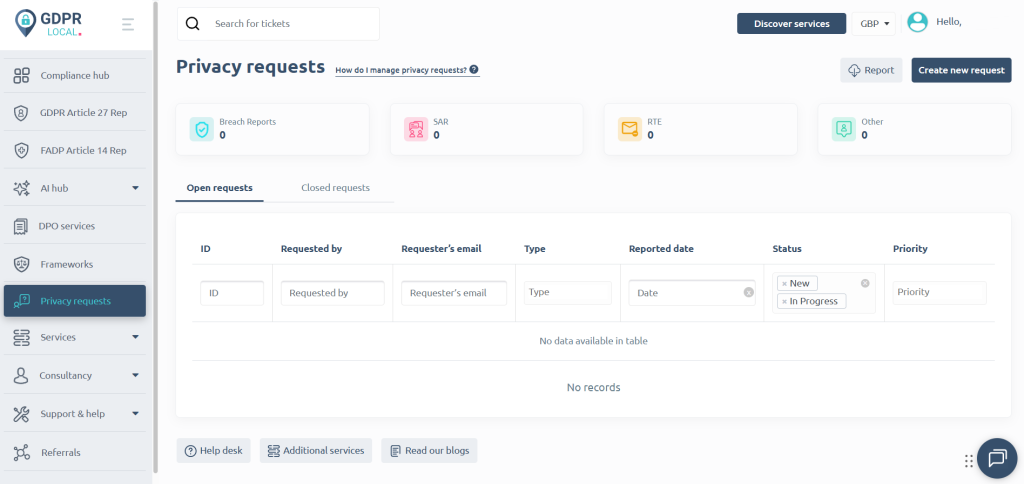
The first is representation. If you process the data of people in the EU or UK without being established there, the law may require you to appoint a local representative as a point of contact for regulators and individuals. Pairing your DPO with EU and UK representation means these connected duties are handled by one coordinated team.
The second is software. The right tools make compliance easier to run day to day, from managing records of processing to handling data subject requests and tracking consent. When your software works hand in hand with your DPO and representation, the whole system stays consistent.
Joining these three elements gives you a single, coherent setup – you see the full picture, and nothing falls through the gaps between providers.
Conclusion: Protect Your Data, Power Your Growth
A Data Protection Officer is a partner that keeps your data safe and leaves your teams free to build, sell, and grow.
You now know what a DPO does, and how the role is defined by Articles 37 to 39 of the GDPR. You know the three cases where appointing one is mandatory, and the practical reasons many businesses appoint one even when they are not required to. You have seen why independence matters, what a full service covers day to day, and how outsourced DPO services compare with an in-house hire on cost, skills, cover, and independence.
The right setup protects you from fines and lost trust. It catches problems early, keeps your framework current, and gives you an expert to turn to when it counts.
If you’re ready to put that setup in place, GDPRLocal can help you build it, one phase at a time.
Protect your data and power your growth.
Talk to our specialists about DPO services, EU and UK representation, and the tools to tie it all together.
Talk to an expert.
Book a ConsultationFrequently Asked Questions
What is a data protection officer?
A data protection officer (DPO) is an independent expert who ensures an organisation follows data protection laws and protects personal user information.
What are the responsibilities of a Data Protection Officer?
The DPO is responsible for monitoring internal compliance and ensuring that the company or organisation processes personal data in compliance with data protection laws. The Data Protection Officer should cooperate with organisational units involved in processing personal data, like Marketing, HR, or Legal.
Is a DPO an employee?
Who can fulfil the role of Data Protection Officer (DPO)? The DPO can be an existing employee with sufficient knowledge of GDPR (if the employee’s professional tasks are compatible with those of the DPO and this does not lead to conflicts of interest) or an external person.
What is a DPO service?
Data protection officers and their DPO services assist you in monitoring internal compliance, informing and advising on your data protection obligations, providing advice regarding Data Protection Impact Assessments (DPIAs) and acting as a contact point for data subjects and the Information Commissioner.
Is a DPO mandatory in GDPR?
Under the GDPR, certain organisations are required to appoint a designated Data Protection Officer (DPO). Organisations are also required to publish the details of their DPO and provide these details to their national supervisory authority.
Which organisations need to appoint a DPO?
Under GDPR, organisations must appoint a DPO if they are a public authority, carry out large-scale monitoring of individuals or process special category data on a large scale.
Can a DPO be outsourced?
While a DPO doesn’t have to be a full-time role, it does require specialist data protection expertise. Having access to an experienced and knowledgeable outsourced DPO is a cost-effective solution for improving information security and compliance with data protection laws, such as the GDPR.

About the Author
Sales & Business Development Consultant
Ana Mishova is a Sales & Business Development Consultant at GDPRLocal, the UK’s fastest-growing B2B compliance partner. With four years at the company, she has experience across operations, from creating processes and shaping compliance services to driving growth through sales, marketing, and strategic partnerships.
Her prior experience includes working closely with current and prospective clients and coordinating with stakeholders to design and plan compliance products. She has led internal change initiatives, driven sales, and guided organisations in selecting the most appropriate compliance strategies.
She holds a degree in psychology, which enhances her ability to connect with people and understand their needs. At GDPRLocal, she works with colleagues to strengthen the sales function and plays an active role in developing the sales strategy.