Do You Need a GDPR Representative? A Guide to Requirements, Rules, and Setup
You can run your entire business outside Europe and still be subject to European privacy law. Your location does not decide this. Your users do. The moment someone in the EU, UK, or Switzerland uses your product, visits your site, or appears in your data, European privacy rules apply to you.
Three laws set the same core rule. EU GDPR (Article 27), UK GDPR (Article 27), and the Swiss FADP (Article 14) each require many non-European companies to appoint a local representative: a named point of contact in Europe for regulators and for the people whose data you hold.
Appointing one is easy, and the payoff is big. Done right, compliance becomes proof that you are safe to buy from. The challenge, though, is covering three legal systems at once. (GDPRLocal was built to solve exactly that, fast and without the usual legal bill.)
So, who needs a GDPR representative? What does skipping one cost you? How do the EU, UK, Swiss, and AI rules differ? And how fast can you get one in place? Below are the answers, from the legal triggers to a five-minute setup!
Príomhghnéithe
• Extraterritorial reach: Serving or tracking European users triggers local privacy laws, regardless of company location.
• EU GDPR Article 27: Non-EU businesses targeting EU users need a local representative or face fines up to €10M.
• Post-Brexit UK rules: The UK requires a separate representative, with fines up to £8.7M for non-compliance.
• Swiss FADP mandate: Swiss privacy law requires representation and threatens executives with personal criminal fines.
• EU AI Act coverage: Non-EU AI providers launching models in Europe must appoint an Authorised AI Representative.
• Exemption restrictions: Modern digital businesses rarely qualify for the “occasional processing” exemption.
• Commercial risks: Lacking representation risks heavy fines, stalled enterprise sales, and failed vendor audits.
• Representative vs subsidiary: Article 27 representation fulfils legal duties at a fraction of a subsidiary’s cost.
• Fast setup: Platforms like GDPRLocal provide full European coverage and compliance templates in minutes.
What Is a GDPR Representative, and Why Might You Need One?
A European representative is your official local point of contact in Europe. When a data protection authority or a European user wants to contact you about personal data, they contact your representative, who can address regulators and users directly within their own region.
Compliance in Europe now rests on two core foundations: data protection law (EU GDPR, UK GDPR, and Swiss FADP) and AI product regulation (the EU AI Act). Enforcement under both regimes is escalating – European breach notifications averaged 443 per day this year, a 22% year-over-year increase.
At the same time, 90% of global companies have expanded their privacy programs to manage AI-related risks, according to Cisco’s 2026 Benchmark Study. Selling software in Europe now often requires cover under both regulatory frameworks. The sections below explain the types and who needs which.
Who Needs an EU GDPR Representative Under Article 27?
Article 27 of the EU GDPR applies to any organisation outside the EU that targets people in the 27 member states or the wider EEA. If you offer goods or services to those people, or monitor their behaviour, you fall within the law.
Failure to appoint an EU representative is subject to standard administrative penalties of up to €10 million or 2% of the total annual global turnover, whichever is higher. Regulators enforce this rule actively. The Dutch Data Protection Authority fined US website LocateFamily.com €525,000 for failing to appoint an Article 27 representative. (Source: Fines for Failure to Appoint an EU GDPR Representative)
The representative must be a local entity physically located in an EU member state that data protection authorities and European users can contact. The representative receives inquiries from regulators and users, keeps your processing records available for inspection, and stands as your local point of accountability.
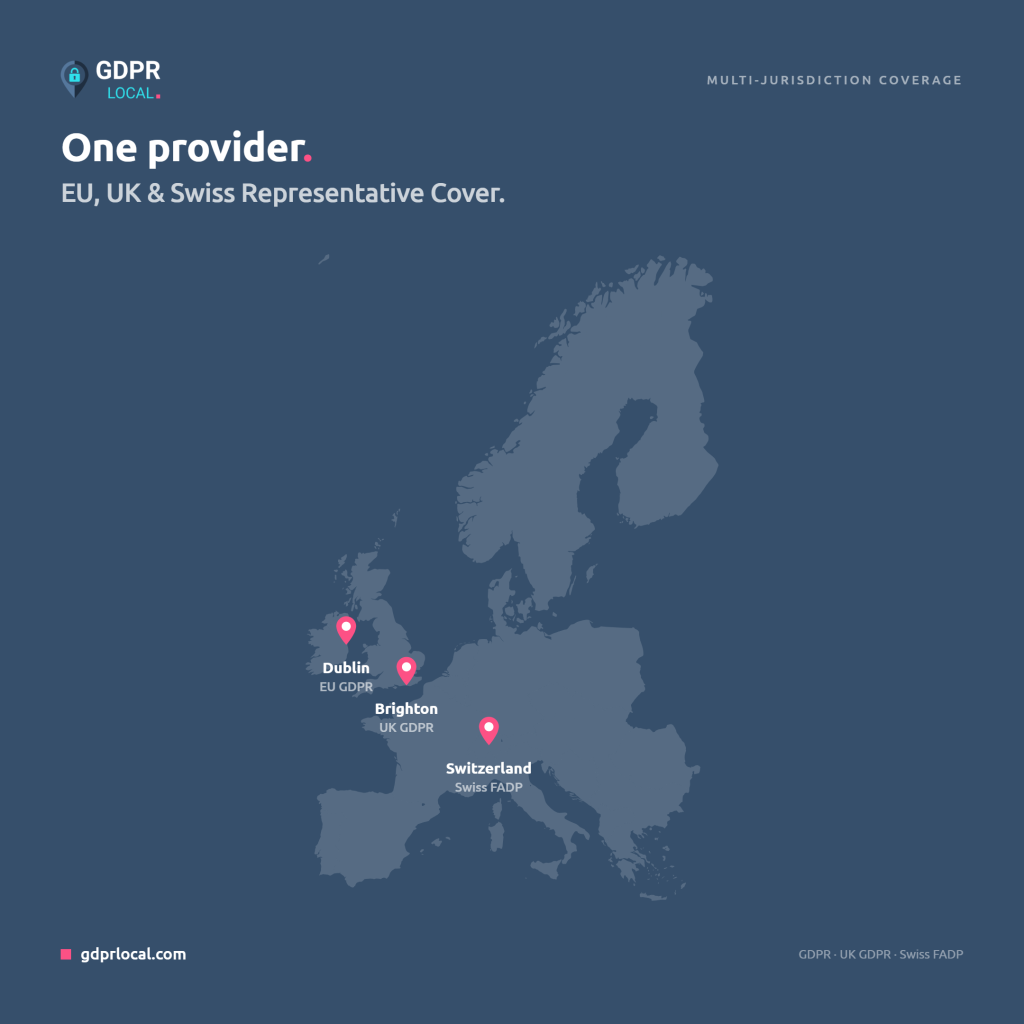
GDPRLocal meets this requirement through its EU operational hub in Dublin, Ireland. Clients get an EU address and a team that manages regulatory contact on their behalf.
Need an EU Representative? We can set you up in minutes.
Tuilleadh EolaisWho Needs a UK GDPR Representative After Brexit?
After Brexit, the UK runs its own independent data protection regime under the Data Protection Act 2018. An EU-based representative or an EU office no longer meets UK law requirements. The two systems are now separate, and each needs its own cover.
Any business without a UK establishment that processes personal data belonging to UK residents must appoint a UK Article 27 representative. This rule applies to companies and organisations located outside the UK that process UK user data. Under UK law, failure to appoint a representative can draw fines from the Information Commissioner’s Office (ICO) of up to £8.7 million or 2% of annual global turnover.
The UK representative acts as the official point of contact for the ICO and UK residents. Your representative’s contact details must be clearly published in your public privacy policy so UK users can exercise their data rights.
GDPRLocal holds a physical headquarters in Brighton, UK. This gives clients direct UK coverage without setting up a UK company. You can add a UK representative on its own or beside your EU representative service in the same account.
Need an EU Representative? We can set you up in minutes.
Tuilleadh EolaisWho Needs a Swiss Data Protection Representative Under FADP Article 14?
Switzerland sits outside both the EU and the UK, and runs its own privacy law: the Swiss Federal Act on Data Protection (FADP). Article 14 of the FADP is the Swiss equivalent of GDPR Article 27.
Foreign companies that process the personal data of people in Switzerland on a large scale, regularly, or with a high risk to privacy must appoint a local Swiss representative. Cover under EU or UK rules does not carry across the Swiss border. Unlike the GDPR, Swiss law imposes personal criminal fines of up to CHF 250,000 directly on responsible company leaders for intentional non-compliance under FADP regulations.
Official guidelines from the Federal Data Protection and Information Commissioner (FDPIC) confirm that foreign businesses must list their Swiss representative in their privacy notice.
GDPRLocal provides native Swiss coverage from its office in Switzerland, so clients hold all three European regimes under one provider.
Need an EU Representative? We can set you up in minutes.
Tuilleadh EolaisWho Needs an EU Authorised AI Representative Under the AI Act?
The EU AI Act introduces a second mandatory compliance pillar for tech, SaaS, and AI companies that fall in the high-risk category. It governs AI models and automated systems placed on the European market, sitting directly beside data protection laws.
Non-EU providers and deployers that launch AI systems into the European market must appoint an authorised EU AI Representative under Article 54 of Regulation (EU) 2024/1689. Failing to appoint an authorised AI representative can trigger statutory fines of up to €15 million or 3% of total worldwide annual turnover, whichever is higher (under Article 99 of the EU AI Act), in addition to potential suspension of products from the EU market.
The representative role under the AI Act is tied to product safety and technical compliance. The representative must hold complete technical documentation on file for 10 years after the AI system is placed on the market.
GDPRLocal runs an AI Law Compliance team. Clients get one single provider that covers data privacy and AI governance together, preventing compliance from falling into separate silos.
Need an EU Representative? We can set you up in minutes.
Tuilleadh Eolais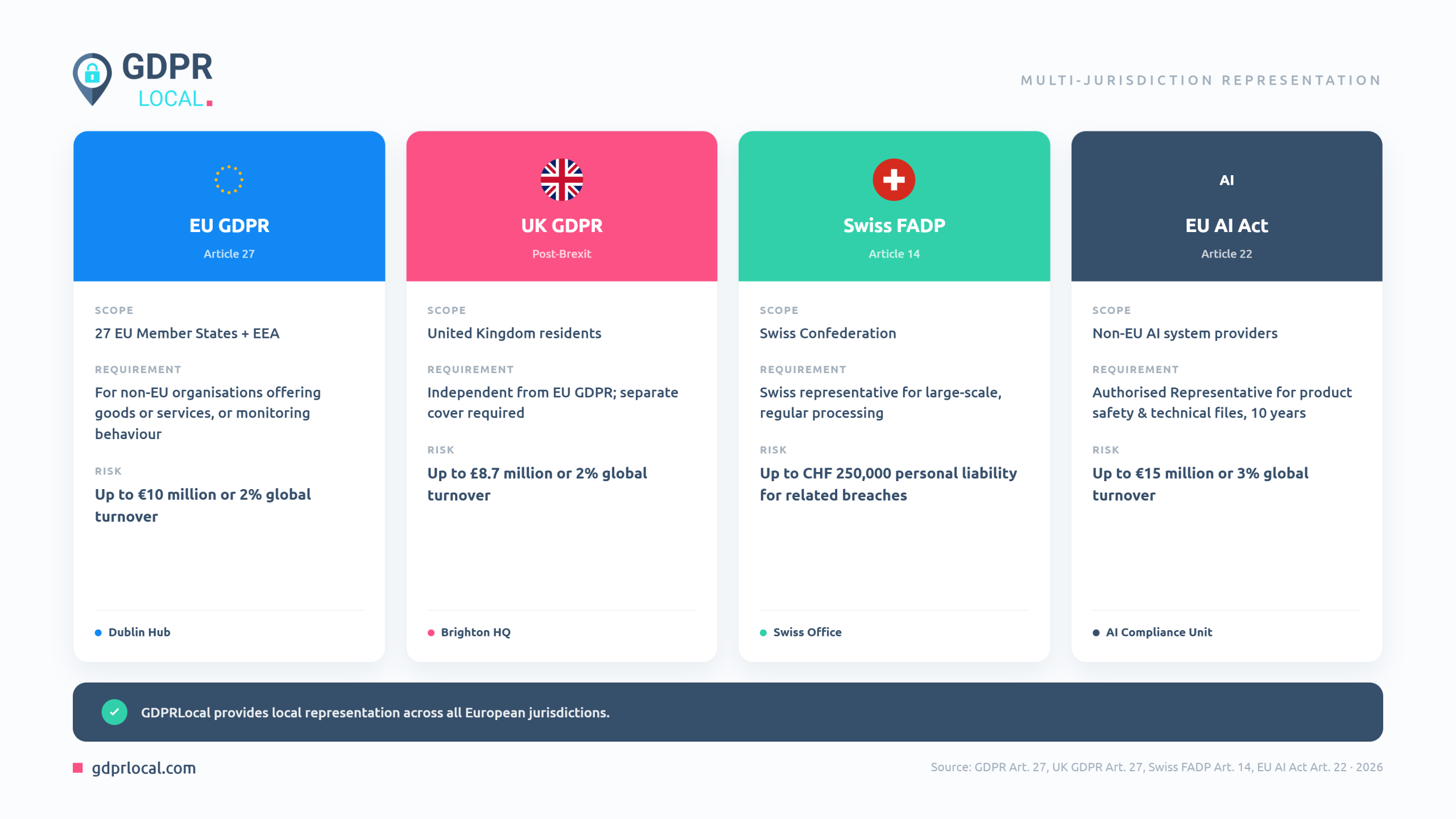
Are You Legally Required to Appoint an Article 27 GDPR Representative?
As we saw earlier, data protection rules apply based on where your users live, not where your company, servers, or staff sit. Under the extraterritorial reach of European privacy law, any business – whether a SaaS platform, startup, e-commerce brand, or AI developer – must comply if it handles data from European residents.
Let’s look at two legal triggers. If your organisation meets either trigger, appointing a local representative is a mandatory duty under Article 27.
Trigger 1: Offering Goods or Services to European Users
Directing goods or services to people in Europe meets the first trigger. European law specifies that no payment is required; offering a free app tier, a trial, or a digital download all bring you under scope.
Regulators evaluate whether a business actively targets the region. Clear indicators of targeting include:
• Displaying website content tailored to European visitors.
• Accepting local currencies like Euros, Pounds, or Swiss Francs.
• Providing local European language options.
• Offering shipping to addresses across Europe.
• Running localised advertising campaigns in European markets.
You do not need to meet all of these criteria. A single clear signal – such as local currency pricing or geo-targeted ads – is enough to bring your business within scope.
Trigger 2: Monitoring User Behaviour or Analytics
Tracking the online actions of people in Europe meets the second legal trigger, even without active sales campaigns. Everyday web tools and background analytics services frequently trigger this requirement.
Monitoring behaviour includes:
• Using tracking pixels or web beacons.
• Running Google Analytics or performance tools.
• Profiling users for targeted advertising.
• Collecting app telemetry and usage metrics.
• Training machine learning models on European user inputs.
If your systems track European users, you are subject to statutory compliance. The GDPRLocal platform automates this ongoing obligation, giving non-EU companies an instant compliance setup across all European markets.
Need an EU Representative? We can set you up in minutes.
Déan Teagmháil LinnCan You Rely on the “Occasional Processing” Exemption?
Rarely. While Article 27(2)(a) contains an “occasional processing” exemption, it applies only under strict conditions. To rely on this exemption, your data processing must satisfy three strict criteria:
• Infrequent: It occurs rarely and stays outside regular operations.
• Low risk: It carries no potential risk to individual rights.
• Non-sensitive: It excludes large-scale handling of sensitive data.
Modern SaaS products, e-commerce stores, and digital tools process user data continuously, causing them to fail this test. Data protection authorities, including the Dutch DPA in its €525,000 fine against LocateFamily.com, explicitly reject the “occasional” defence for platforms that handle user records as part of daily operations.
If personal data flows through your service as part of normal business operations, the exemption does not apply, and appointing an official representative is mandatory.
What Are the Risks of Not Appointing a GDPR Representative?
Non-compliance is a business risk, and skipping Article 27 creates exposure across finance, sales, and brand reputation simultaneously. It slows expansion, damages buyer trust, and leaves executives open to regulatory investigation without local protection.
The three risks below cause the most damage.
Multi-Million Euro Regulatory Fines and DPA Penalties
Article 83 of the GDPR classifies representative compliance under its standard penalty tier, exposing non-compliant businesses to fines of up to €10 million or 2% of worldwide turnover. Rather than being a minor formality, skipping this duty carries immediate financial risk.
European DPAs are active. Ireland’s DPC, France’s CNIL, and the UK’s ICO all deal with non-EU and non-UK entities that operate without local representation. Without a local address, a routine DPA inquiry has nowhere to go. This makes it more likely to escalate into a formal enforcement action rather than a quiet exchange.
A representative gives regulators a first point of contact. That single step often keeps a matter at the inquiry stage instead of the penalty stage.
Blocked Enterprise Deals and Sales Friction
This is the risk that costs revenue. European enterprise buyers, B2B procurement teams, and corporate legal departments conduct strict vendor security audits before signing.
If a vendor cannot supply a valid EU, UK, or Swiss Representative agreement during procurement, the security review fails. The deal collapses at the moment it should close. For a SaaS or tech vendor, that means a lost pipeline and a slower sales cycle.
A vendor reaches the final stage of a large European contract when a legal questionnaire requests the Article 27 representative’s details. With no answer ready, the deal pauses while the vendor rushes to set one up. Weeks of momentum are lost, and a competitor with cover in place can step in.
Holding representation in place turns this around. GDPRLocal representation keeps the momentum going: when procurement asks for proof, you supply a signed agreement and keep the sale moving.
Escalated Data Breaches and Unmanaged Customer Complaints
Handling a privacy incident from another continent is hard and slow. When a person in Europe files a Subject Access Request (SAR), a right-to-erasure notice, or a breach inquiry, the clock starts at once. Missed deadlines and poor handling can trigger a regulatory investigation on their own.
A representative acts as a first line of defence. GDPRLocal triages complaints, answers users in their own region, and manages communication with regulators. Small issues get resolved before they grow into formal disputes, and legal deadlines get met.
Don’t let privacy compliance slow your European growth.
Get fully covered across the EU, UK, and Switzerland in under 5 minutes with instant written representation agreements and complete DPA protection.
Appoint Your Representative NowRepresentative, DPO, or Local Office: Which Setup Do You Need?
Many non-European businesses get their setup wrong in one of two ways. Some overspend on a full corporate presence they do not need. Others mix up a Representative (Article 27) with a Data Protection Officer (Article 37) and end up buying the wrong service. This section helps leadership and legal teams pick the right level. GDPRLocal provides both Article 27 Representation and full outsourced DPO services so that you can match the service to the duty.
What’s the Difference Between a Representative and a DPO?
• An Article 27 representative is an external liaison required for companies based outside Europe. It is the public-facing point of contact for European citizens and DPAs. It represents the company to the outside world.
• A Data Protection Officer (DPO) is an independent supervisor, internal or external, required for companies that handle high-risk, large-scale, or public-sector data. The DPO oversees internal strategy, audits compliance, and advises management.
A Representative represents the company externally, while a DPO advises the company internally. Growing tech, health, and high-volume SaaS companies often need both at once. GDPRLocal supports both paths under one provider through its outsourced DPO service, so the two roles work together.
Don’t let privacy compliance slow your European growth.
Get fully covered across the EU, UK, and Switzerland in under 5 minutes with instant written representation agreements and complete DPA protection.

Get started in minutes — no credit card required.
Appoint Your Representative NowIs a Representative Cheaper Than a European Subsidiary?
Yes, by a wide margin. A common question from global executives is whether selling in Europe means opening a physical office or a local subsidiary. It does not.
Setting up a corporate entity in the EU, the UK, or Switzerland entails significant overhead: local company registration, tax obligations, legal fees, and months of administrative work. That is a high cost for what is, in many cases, a compliance need rather than an operational one.
Appointing an Article 27 representative gives you a legal presence in Europe without any of that. GDPRLocal delivers cover across Dublin, Brighton, and Switzerland in about 5 minutes, at a small fraction of the cost of a subsidiary.
| Factor | European subsidiary | Article 27 representative |
| Setup time | Weeks to months | About 5 minutes |
| Ongoing cost | High: tax, filings, staff | Low, fixed fee |
| Admin burden | Company accounts and reporting | None on your side |
| Legal presence in Europe | Tá | Tá |
How Does GDPRLocal Get You Compliant in 5 Minutes?

Traditional legal consultancies move slowly. Setup can take weeks of back-and-forth before anything is signed. GDPRLocal uses a digital-first process so that you can complete representation today.
Instant Sign-Up and Written Representation Agreement
The registration process takes about five minutes. You enter your company details, choose the regimes you need (EU, UK, Swiss, or all three), and complete sign-up online.
At the end, you download your signed Written Representation Agreement. This document is your legal proof that a representative is in place. You have it in hand immediately so that you can answer a procurement request or a regulator the same day.
Free Included Compliance Templates

Every account includes a set of free, ready-to-use compliance templates. These save you from drafting core documents from scratch.
The included templates are:
• Record of Processing Activities (ROPA).
• SAR response frameworks for handling Subject Access Requests.
• Breach response policies.
• Information Security templates.
• Privacy policy template.
Each one is a working starting point. You update it with your own details and upload it, rather than paying a law firm to build it line by line.
Completing Verification and Publishing Privacy Policy Updates
The final step makes your compliance public. Once verification is complete, you add your new EU, UK, or Swiss representative details to your website’s privacy policy.
This is a required part of the law. The people whose data you hold must be able to find and contact your representative. Publishing the details in your privacy policy closes the loop and puts you in full public compliance.
Ready to publish your compliant privacy policy today?
Join hundreds of global businesses using GDPRLocal to secure official EU/UK/Swiss representation beside free, turn-key compliance templates.
Get started in minutes — no credit card required.
Get Started in 5 Minutes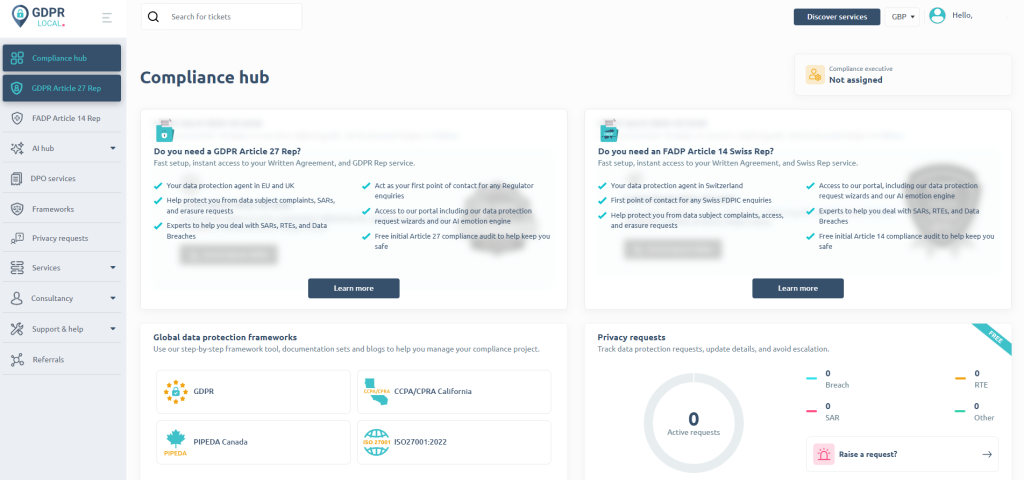
What’s Inside the GDPRLocal Compliance Hub & Request Portal?
Representation is more than a signed document. GDPRLocal pairs certified privacy consultants with a portal for tracking SARs, managing vendor risks, and logging breach alerts. You get automated compliance workflows and expert oversight in one place, keeping day-to-day privacy management effortless.
How Does the Request Management Wizard Handle SARs, RTE, and Breaches?

The portal includes a wizard that manages incoming requests. When a Subject Access Request (SAR) or a Right to Erasure (RTE) inquiry arrives, the wizard logs it and starts tracking the legal deadline.
These requests come with strict time limits. The wizard keeps each one visible and on schedule, so a response is never missed by accident. Breach records are tracked in a single place, keeping your incident history in a single clear view.
What Does the Vendor Manager and EU/UK/Swiss Dashboard Do?
The dashboard gives you a view of your European compliance. From a single screen, you can oversee third-party privacy risk, track your representative’s activity, and manage data risk across all three regimes. The Vendor Manager lets you monitor the privacy standing of the suppliers you work with. Instead of chasing this across spreadsheets and inboxes, you manage it from one unified place.
Step-by-Step Guidance and Custom Template Responses
Some inquiries are tricky, whether from a user or a regulator. The portal includes a library of response templates drafted by experts, matched to common request types. When a difficult request arrives, the portal guides your team step by step and suggests a suitable template response. Your staff answer with confidence, even when they are not privacy specialists.
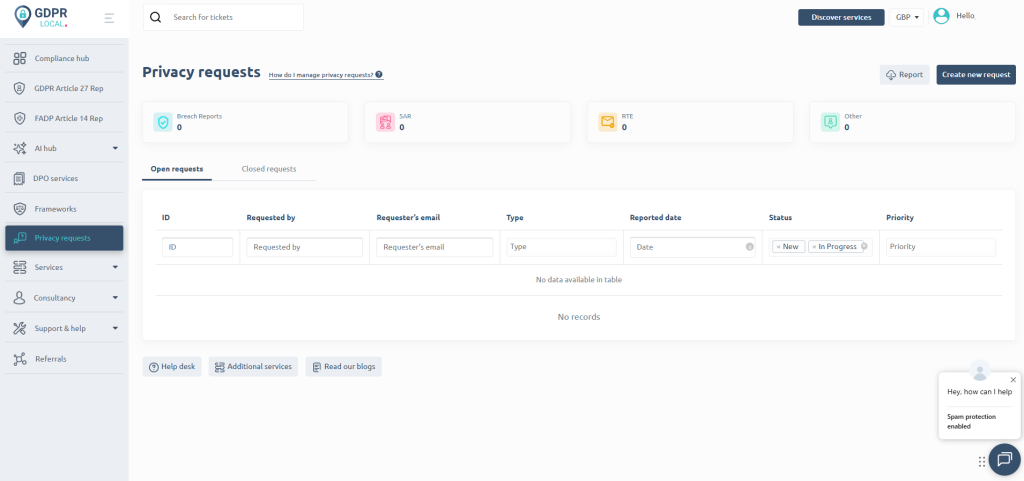
How GDPRLocal Handles Inquiries
You get more than a compliance service. GDPRLocal provides a team of more than 30 certified data protection consultants acting as your first line of defence. We triage complaints, provide SAR consultancy, and advise your team on how to resolve inquiries effectively so small issues never escalate.
How Are Customer Complaints Resolved Before They Escalate?
Most complaints can be settled early if handled well. GDPRLocal triages each incoming complaint, manages the communication, and calms user frustration before it grows. A frustrated user who feels heard rarely goes to a regulator. By resolving issues in the user’s region and language, GDPRLocal keeps most complaints out of the regulatory system entirely.
How Are DPA Inquiries and Regulator Investigations Managed?
When a European regulator opens an inquiry, you get hands-on support. GDPRLocal works with you to handle the inquiry and prepare a professional response to the legal and technical points. This gives you a trained team standing between your business and the regulator, rather than a founder trying to answer a formal notice alone. The result is a calmer, faster, and safer process.
Turn European Compliance Into Faster Growth
Handled well, European compliance is proof that your business is safe to buy from, which shortens sales cycles and builds trust with European buyers.
GDPRLocal gives you that proof: setup in about five minutes, native presence in the EU, the UK, and Switzerland, free, ready-to-use templates, and a full portal with expert support. One provider covers every regime, so you spend minutes on compliance and keep your focus on the market.
If people in Europe use your product or appear in your data, the duty already applies. The only choice is whether to meet it before it costs you a deal or a fine.
Frequently Asked Questions
1. What is a GDPR representative?
A GDPR representative is a local person or organisation based in the European Union (or the UK) appointed in writing by a company located outside that region. This representative serves as a direct local point of contact for data protection authorities and individuals regarding data privacy rights and compliance.
2. What is a GDPR Article 27 representative?
Article 27 of the EU General Data Protection Regulation (GDPR) requires organisations that are not established in the European Union (EU) to designate a representative in the EU if they are subject to the GDPR. Certain non-EU EY Network entities may engage in processing activities that fall within the scope of the GDPR.
3. What is the difference between DPO and EU representatives?
The DPO’s role is internally focused on compliance, while the EU Representative’s role is externally focused on representation. Mixing these roles can lead to a conflict of interest because the priorities and obligations of each role are different.
4. Do I need an EU representative?
Most non-EU businesses need an EU representative according to the GDPR. If your company does not have an office, branch or other establishment in the EU, but does business with European clients, you may have to appoint an EU representative.
5. What is a local representative’s role in GDPR?
The representative acts on your behalf as a local point of contact for data subjects and data protection authorities in the EEA and/or the UK. They also help you maintain your record of processing activities (ROPA).
6. What is an Article 27 representative?
EU and UK Representative Services Required by GDPR Article 27. Article 27 of the GDPR requires organisations that offer goods or services, or monitor the behaviour of EU residents, to designate a point of contact in at least one EU member state.
7. Do I need a separate UK representative if I already have an EU representative?
Yes, and it works both ways. UK GDPR is a separate legal regime from EU GDPR since Brexit, so an EU representative or EU office does not satisfy the UK requirement, and a UK representative does not satisfy the EU requirement either. If your company has no establishment in the UK and processes data from UK residents, you need a UK-based representative under UK GDPR Article 27. If you have no establishment in the EU and process EU residents’ data, you need a separate EU-based representative under EU GDPR Article 27. Each regime needs its own cover.
8. Is there a difference between UK GDPR and EU GDPR?
Data protection standards: While the fundamental principles and rights of data subjects remain largely the same, the UK GDPR differs from the EU GDPR in certain areas, such as data breach notification requirements, the appointment of data protection officers, and exemptions for certain public authorities.
Disclaimer: This blog post is intended solely for informational purposes. It does not offer legal advice or opinions. This article is not a guide for resolving legal issues or managing litigation on your own. It should not be considered a replacement for professional legal counsel and does not provide legal advice for any specific situation or employer.

About the Author
Ana Mishova
Sales and Business Development Consultant — GDPRLocal
Ana focuses on helping organisations understand their compliance obligations and find the right data protection solutions. At GDPRLocal she works closely with businesses of all sizes, making GDPR and privacy compliance clear, practical, and accessible.

About the Author
Sales & Business Development Consultant
Ana Mishova is a Sales & Business Development Consultant at GDPRLocal, the UK’s fastest-growing B2B compliance partner. With four years at the company, she has experience across operations, from creating processes and shaping compliance services to driving growth through sales, marketing, and strategic partnerships.
Her prior experience includes working closely with current and prospective clients and coordinating with stakeholders to design and plan compliance products. She has led internal change initiatives, driven sales, and guided organisations in selecting the most appropriate compliance strategies.
She holds a degree in psychology, which enhances her ability to connect with people and understand their needs. At GDPRLocal, she works with colleagues to strengthen the sales function and plays an active role in developing the sales strategy.