
GDPR Data Residency Requirements: Where Must Data Be Stored?
Updated: June 2026
The General Data Protection Regulation (GDPR) imposes strict data residency requirements that affect businesses worldwide, not just those within the European Union. For organisations handling the data of EU residents, compliance is a core business obligation. Understanding where and how you store personal data matters for legal compliance, as local laws and regulations affect how data is managed and stored.
Key Takeaways
• GDPR mandates strict data residency requirements, ensuring personal data of EU residents is stored and processed within specific geographic locations or under adequate safeguards.
• Organisations worldwide must comply with GDPR when handling EU citizens’ data, regardless of their physical location.
• Data residency requirements can vary significantly between different countries, making compliance more complex for multinational organisations.
• Non-compliance with GDPR data residency requirements can result in significant financial penalties and reputational damage.
What is GDPR and why does it apply to data residency?
The General Data Protection Regulation (GDPR) is a comprehensive data protection law that regulates the processing of personal data of EU residents. Implemented in May 2018, this regulation fundamentally changed how organisations worldwide must handle personal information.
GDPR aims to protect the privacy and security of individuals’ data, ensuring that organisations handle sensitive data responsibly and transparently. The regulation applies to any organisation that processes the data of EU citizens.
Non-EU organisations processing EU residents’ data also need to appoint a local representative under Article 27. GDPRLocal’s EU/UK Rep service covers that requirement.
Data residency refers to the physical or geographical location where an organisation’s data is stored and processed. Under GDPR, data residency requires organisations to store and process personal data within specific geographic locations or implement appropriate safeguards when transferring data across borders.
What does GDPR require for data security and minimisation?
Data security is a key component of GDPR compliance, ensuring that both technical protection – such as encryption and access controls – and organisational measures, including staff training and documented policies, are in place.
The regulation emphasises data minimisation, requiring organisations to collect and process only the data necessary for their stated purposes. When handling sensitive information, organisations must be especially cautious to comply with data privacy laws and protect personal data. This principle requires businesses to carefully evaluate which personal data they truly need rather than indiscriminately gathering information.
Data protection principles such as lawfulness, fairness, and transparency guide organisations in their handling of personal data. These principles require that:
• All processing must have a lawful basis (such as explicit consent or legitimate interests)
• Processing must be fair to the data subject
• Organisations must be transparent about how they use personal data
GDPR also introduces enhanced rights for data subjects, including the right to access, rectify, and erase their data. The right to data portability allows individuals to obtain their data in a machine-readable format and transfer it to another service provider. These rights significantly expand individuals’ control over their information and increase organisational obligations.
What does GDPR require for data residency?
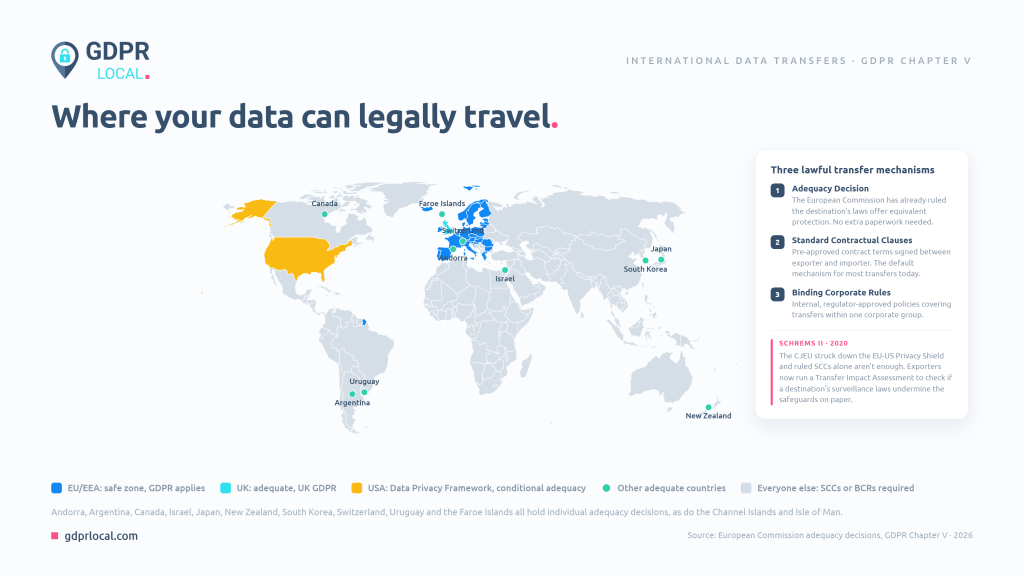
While the GDPR doesn’t strictly require that all EU-resident data remain within the EU/EEA, it places significant emphasis on data residency through stringent requirements for international data transfers. This means that organisations worldwide that process EU citizen data must ensure adequate protection is in place if the data leaves the EU or EEA. These precautions include relying on adequacy decisions by the European Commission, implementing legally binding instruments like Standard Contractual Clauses (SCCs), or establishing Binding Corporate Rules (BCRs).
The invalidation of frameworks like the EU-US Privacy Shield, as seen in decisions such as Schrems II, underscores the dynamic nature of these requirements and the ongoing need to reassess transfer mechanisms. For global businesses, this ever-evolving regulatory landscape requires constant vigilance, careful data mapping to pinpoint data locations, and strong contractual agreements with all data processors. Failure to implement appropriate transfer mechanisms or to regularly review their validity can result in severe penalties.
What are the GDPR data protection principles?
The General Data Protection Regulation (GDPR) establishes a set of core data protection principles that every organisation must follow when processing personal data. These principles apply to all data processing activities and are necessary to ensure compliance with the regulation and to maintain the trust of customers and stakeholders.
Personal data must be processed lawfully, fairly, and transparently. Organisations must communicate to data subjects how their data will be used, ensuring that all processing is done with explicit consent or another valid legal basis. Transparency and fairness are central to building trust and demonstrating accountability.
Data minimisation requires organisations to collect and process only the personal data that is strictly necessary for their specified purposes. This reduces the risk of unnecessary data exposure and helps organisations comply with data protection laws. Organisations must also ensure that all personal data is accurate, complete, and kept up to date, correcting or deleting inaccurate information without delay.
GDPR also mandates that organisations implement appropriate technical and organisational measures to safeguard the security and confidentiality of personal data. This includes protecting data against unauthorised access, accidental loss, or destruction. Adhering to these principles is not only a legal requirement but also a necessary step to maintain customer confidence and avoid severe penalties for non-compliance, which can reach up to 20 million euros or 4% of the company’s annual global turnover.
What is the role of the data controller under GDPR?
The data controller determines the purposes for which and the means by which personal data is processed.
Data controllers must ensure they have a lawful basis for processing personal data, such as explicit consent, contractual necessity, legal obligation, vital interests, public interest, or legitimate interests. Each basis has specific requirements and limitations that controllers must understand and document.
Organisations must also implement appropriate safeguards to protect personal data, including:
• Data encryption both in transit and at rest
• Strong access controls limiting data access to authorised personnel
• Regular security assessments and updates
• Data protection impact assessments for high-risk processing
Data controllers are accountable for ensuring that their data processing activities comply with GDPR requirements, even when using third-party processors. This includes conducting due diligence on vendors, establishing data processing agreements with sufficient guarantees, and maintaining internal rules governing data handling practices.
An outsourced Data Protection Officer can take that accountability, overseeing vendors and ensuring your processing activities comply with GDPR requirements.
When working with data processors, controllers must ensure that these third parties provide sufficient guarantees to implement appropriate technical and organisational measures that meet GDPR requirements and protect the rights of data subjects. Effective compliance requires clear communication and agreements between all parties involved in data processing.
What happens when a data breach occurs under GDPR?
Data breaches can have severe consequences under GDPR, including significant financial penalties and reputational damage that may far exceed direct regulatory costs. A data breach under the GDPR refers to any security incident that leads to the accidental or unlawful destruction, loss, alteration, unauthorised disclosure of, or access to personal data.
Organisations must notify the relevant supervisory authority within 72 hours of becoming aware of a data breach that poses risks to individuals’ rights and freedoms. When the breach is likely to result in a high risk to affected individuals, organisations must also inform the data subjects without undue delay.
GDPR emphasises the importance of preventing data breaches through strong security measures and regular data protection impact assessments. Organisations should:
• Implement comprehensive security policies
• Regularly test and evaluate security measures
• Train staff on data protection responsibilities
• Create and test breach response plans
GDPRLocal, through the Compliance Hub, can help with data breach management from start to finish.
Non-compliance with GDPR can result in fines of up to 4% of an organisation’s global annual turnover or €20 million, whichever is higher. These penalties apply not only to data breaches but to any violation of the regulation’s requirements, making comprehensive compliance necessary for all organisations handling EU residents’ data.
How does GDPR fit within the broader data privacy regulatory landscape?
GDPR is part of a broader landscape of data privacy laws and regulations that organisations need to consider. This regulatory environment includes national laws implementing GDPR, sector-specific regulations, and other international data protection frameworks.
Businesses face a genuine challenge with data residency: they must keep up with many different rules, some of which may conflict. Enforcing data residency requires ongoing monitoring and adaptation to different legal requirements across jurisdictions. This is particularly challenging for businesses operating in multiple regions with varying approaches to data protection.
Data sovereignty laws, such as those in the EU, require organisations to store and process personal data within specific geographic locations or jurisdictions. These laws are based on the principle that data is subject to the laws of the country where it is physically stored.
The interplay between GDPR and other frameworks, such as the invalidated EU-US Privacy Shield agreement, adds complexity. The July 2020 Schrems II decision by the Court of Justice of the European Union invalidated the Privacy Shield, creating significant challenges for cross-border data transfers between the EU and the United States. GDPR does allow specific derogations, such as data transfers necessary for the establishment, exercise, or defence of legal claims.
Understanding the relationships among different data privacy laws and regulations is necessary to ensure comprehensive compliance, especially for organisations operating globally. Companies must remain aware of evolving requirements across all jurisdictions in which they process data.
Conclusion
GDPR data residency requirements are complex and require organisations to implement strong security measures to safeguard personal data. Understanding the regulations and their requirements is necessary to ensure compliance and avoid financial penalties that can significantly affect your business.
Global organisations face a real balancing act with data residency. The rules are complex and constantly evolving due to new laws, court rulings, and regulatory updates, so staying informed is necessary.
Frequently Asked Questions
What are GDPR data residency requirements?
GDPR data residency requirements mandate that personal data of EU residents must be stored and processed within specific geographic locations or under adequate safeguards to ensure compliance with data protection laws.
Can personal data be transferred outside the EU under GDPR?
Yes, personal data can be transferred outside the EU only if the receiving country has an adequacy decision from the European Commission or if appropriate safeguards, such as binding corporate rules or standard contractual clauses, are in place.
What happens if an organisation fails to comply with GDPR data residency requirements?
Non-compliance can result in significant fines of up to 20 million euros or 4% of the organisation’s global annual turnover, as well as reputational damage and potential legal consequences.

About the Author
Ana Mishova
Sales and Business Development Consultant — GDPRLocal
Ana focuses on helping organisations understand their compliance obligations and find the right data protection solutions. At GDPRLocal she works closely with businesses of all sizes, making GDPR and privacy compliance clear, practical, and accessible.

About the Author
Sales & Business Development Consultant
Ana Mishova is a Sales & Business Development Consultant at GDPRLocal, the UK’s fastest-growing B2B compliance partner. With four years at the company, she has experience across operations, from creating processes and shaping compliance services to driving growth through sales, marketing, and strategic partnerships.
Her prior experience includes working closely with current and prospective clients and coordinating with stakeholders to design and plan compliance products. She has led internal change initiatives, driven sales, and guided organisations in selecting the most appropriate compliance strategies.
She holds a degree in psychology, which enhances her ability to connect with people and understand their needs. At GDPRLocal, she works with colleagues to strengthen the sales function and plays an active role in developing the sales strategy.