Empower Your AI Strategy: ISO/IEC 42001 Implementation
In our blogs “The EU’s Artificial Intelligence Act and Its Implications for Business” and “Essential Guide for the New EU AI Act: Navigating through the AI Act”, we explored the transformative impact of the EU’s regulatory measures on companies, shedding light on significant milestones, regulatory requirements, and pertinent considerations. These blogs underscored the Act’s role in overseeing AI systems based on their associated risks, prohibiting certain applications deemed detrimental to rights and democratic principles, while imposing obligations on high-risk systems and general AI.
In this article, we shift our focus to ISO/IEC 42001:2023, Information technology – Artificial intelligence – Management system, and explain its relevance to implementing AI management systems in organisational contexts.
ISO/IEC 42001: A Blueprint for AI Management
AI has emerged as a game-changing force, revolutionising the way we live and work. As we continue to witness the rapid growth and integration of AI in various industries, it has become crucial for organisations to adopt a structured approach towards managing this powerful tool.
This is where ISO/IEC 42001 comes in, providing a comprehensive framework for implementing and managing AI systems.
What is ISO/IEC 42001 for?
ISO/IEC 42001 is a guiding framework in the ever-evolving realm of AI, helping organisations navigate the complexities and challenges of implementation.
This international standard sets out requirements for establishing, implementing, maintaining, and continually improving AI management systems within organisations, including those that provide or use AI-based products or services.
Designed to address the multifaceted nature of AI technology, ISO/IEC 42001 serves as a comprehensive guide for organisations of all sizes and across diverse industries. By providing a structured framework for AI management, it helps entities manage risks and capitalise on opportunities associated with AI deployment while striking a delicate balance between innovation and governance.
Structured Approach: Implementing ISO/IEC 42001 in Your Organisation
ISO/IEC 42001 provides a structured framework for managing Artificial Intelligence Management Systems (AIMS) within organisations. It provides a blueprint for responsible AI development and use, covering ethics, transparency, and continuous learning.
Now, let’s explore some examples of AI-based products and services:
Virtual Assistants
These include chatbots, voice assistants (like Siri or Google Assistant), and customer service bots that utilise natural language processing (NLP) to interact with users.
Recommendation Systems
AI algorithms analyse user preferences and behaviour to offer personalised suggestions. For instance, Netflix suggests movies, and Amazon recommends products.
Image Recognition
AI-powered systems identify objects, people, or scenes in images. Applications range from facial recognition to security surveillance and medical imaging.
Autonomous Vehicles
Self-driving cars and drones rely on AI for navigation, obstacle detection, and decision-making.
Healthcare Diagnostics
AI assists in medical diagnosis by analysing images (such as X-rays or MRIs) and predicting diseases.
Natural Language Processing (NLP)
AI models process and understand human language. Examples include language translation, sentiment analysis, and text summarisation.
Fraud Detection
AI algorithms detect anomalies in financial transactions to prevent fraud.
Predictive Analytics
AI predicts future outcomes based on historical data, benefiting fields like finance, marketing, and supply chain management.
Gaming
AI opponents in video games adapt strategies based on player behaviour.
Smart Home Devices
Devices like smart thermostats, lights, and security cameras use AI to automate and optimise.
These examples fall into different risk categories under the EU AI Act.
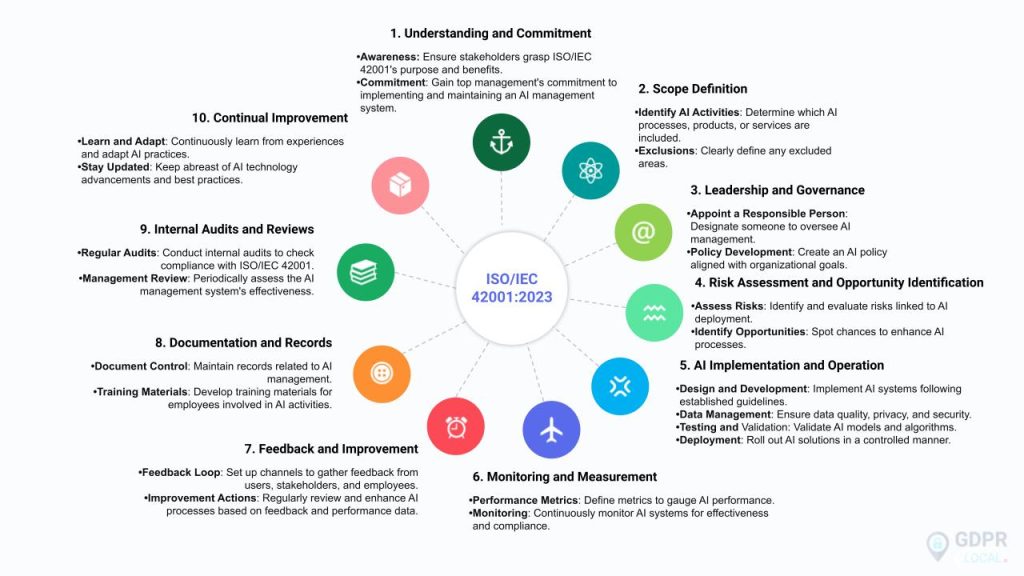
Here is a simplified version of the implementation steps for this standard for companies that are developing or deploying some AI-based products and services as mentioned above:
Fostering Responsible AI: Ethical Considerations and Transparency
At its essence, ISO/IEC 42001 fosters responsible AI practices by emphasising ethical considerations and transparency. For instance, it mandates the implementation of safeguards for various AI features, such as:
– autonomous decision-making,
– ensuring accountability, and
– oversight beyond conventional IT systems.
Moreover, by promoting continuous learning and adaptation in AI systems, ISO/IEC 42001 encourages the responsible use of AI technologies over time.
Maximising Benefits: Leveraging ISO/IEC 42001 for Innovation and Compliance
Implementing ISO/IEC 42001 offers benefits for organisations venturing into the AI landscape. Here are a few examples:
Responsible AI Practices
By adhering to ISO/IEC 42001, organisations can establish guidelines and principles for the ethical use of AI, address societal impacts, and align with ethical standards and values. For instance, implementing transparency requirements for AI systems like chatbots ensures accountability and builds stakeholder trust.
Enhanced Reputation
ISO/IEC 42001 helps organisations build and maintain a positive reputation by demonstrating their commitment to ethical AI practices. Adhering to the standard shows an organisation’s commitment to responsible AI deployment, enhancing its credibility and trustworthiness with stakeholders and the public.
Compliance with Legal and Regulatory Standards
ISO/IEC 42001 provides a structured framework that aligns AI practices with relevant regulations, helping organisations avoid legal pitfalls. For example, implementing mandatory human rights impact assessments for high-risk AI deployments helps ensure regulatory compliance and mitigate legal risks.
Effective Risk Management
ISO/IEC 42001 offers practical guidance on managing AI-specific risks, helping organisations identify, assess, and mitigate risks associated with AI implementation. For instance, addressing data privacy and security risks helps ensure the robustness and reliability of AI systems, safeguarding against potential vulnerabilities.
Promoting Innovation
While ensuring responsible AI practices, ISO/IEC 42001 also encourages innovation within defined parameters. By providing a structured framework, organisations can explore and integrate AI technologies in ways that foster creativity and advancement. For example, establishing AI regulatory sandboxes supports real-world testing and innovation in a controlled environment, helping develop cutting-edge AI solutions.
Summary
In summary, ISO/IEC 42001 not only champions responsible and ethical AI practices but also provides a comprehensive framework for organisations to manage risks, comply with regulations, and instil trust in their AI applications. By aligning AI management with established best practices, ISO/IEC 42001 supports sustainable growth and success in the rapidly evolving AI landscape.

About the Author
Head of Commercial & Country Manager
Zlatko Delev is Head of Commercial and Country Manager at GDPRLocal, where he leads the company’s commercial strategy and market presence. He brings international experience across sales, marketing, and customer success, along with a legal background from his studies at Iustinianus Primus Law School in Skopje, Macedonia.
Zlatko sits at the front line of GDPRLocal’s client relationships, guiding organisations through the first stages of their compliance journey and helping them understand where they stand and where they need to go on GDPR, information security, and the emerging landscape of AI regulation. His role bridges commercial strategy with practical data protection knowledge, ensuring clients get clear, actionable direction from their very first conversation with GDPRLocal.
Alongside his commercial focus, Zlatko has trained extensively in project management and organisational leadership, including risk management, stakeholder communication, agile methodology, and digital marketing, a broad skill set that supports his structured, delivery-focused approach to growing GDPRLocal’s business internationally.