Security and Compliance Readiness: The Top Enabler for Scaling AI
In Google Cloud’s 2026 ROI of AI survey, executives named improved security, compliance or regulatory readiness as the top enabler for scaling AI from pilot to production, cited by 46%. The companies seeing the fastest returns also have clearer AI ownership and more structured training. Governance is part of how AI delivers value at scale.
Key Takeaways
- 46% of executives asked named security, compliance or regulatory readiness as an enabler for scaling AI, the most-cited of the top ten enablers in Google Cloud’s 2026 survey.
- The 26% of companies with accelerating AI returns were more likely to report extremely clear AI ownership (48% vs 27%) and to require ongoing AI training (38% vs 18%).
- These practices line up with existing legal duties, such as AI literacy under Article 4 of the EU AI Act and accountability under the GDPR.
What Did Google Cloud’s 2026 ROI of AI Survey Find?
Google Cloud’s 2026 ROI of AI report is based on a survey of 2,403 executives worldwide, carried out with National Research Group. Google Cloud says it analysed 297,782 question responses across industry, geography, company size and stage of AI adoption. It is the third annual edition of the survey.
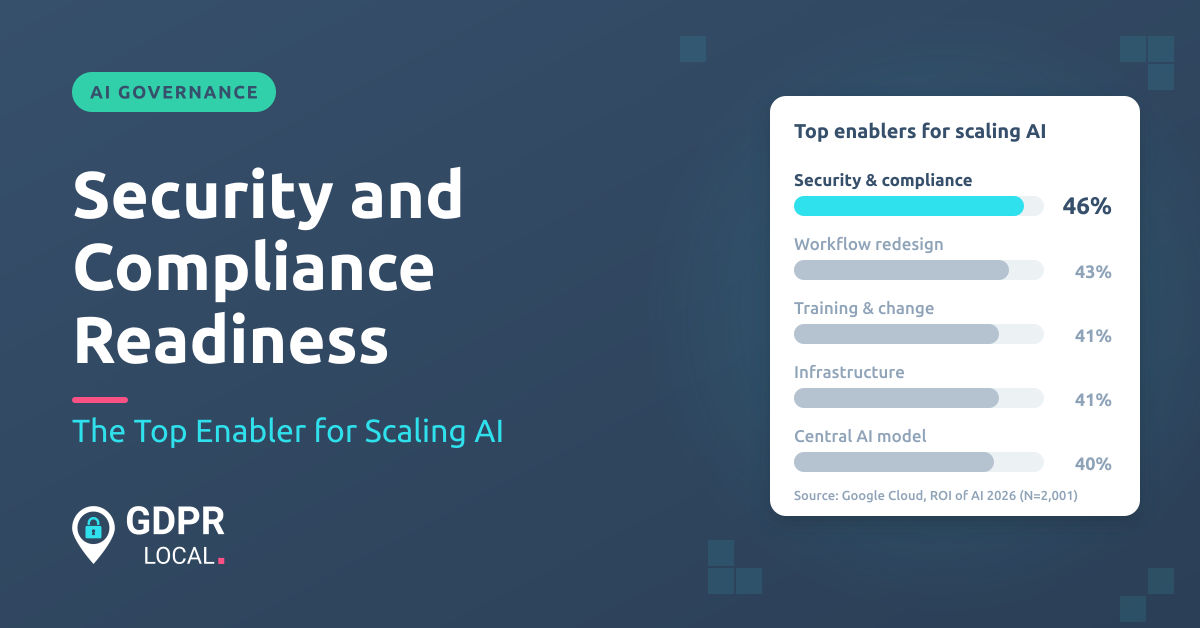
One question asked which capabilities or decisions most enabled organisations to scale AI initiatives from pilot to production and deliver measurable business value. That question had 2,001 respondents. The top answers:
| Enabler | Share of respondents |
|---|---|
| Improved security, compliance or regulatory readiness | 46% |
| Redesign of workflows to embed AI into core processes | 43% |
| Workforce training and change management | 41% |
| Cloud or infrastructure modernisation | 41% |
| Centralised AI operating model (for example, a centre of excellence or hub model) | 40% |
| Clear executive sponsorship and accountability | 39% |
| Vendor strategy optimisation (for example, reducing tool sprawl) | 39% |
| Unified or modernised data infrastructure | 37% |
| Dedicated ROI or value-tracking framework | 37% |
| Standardised tooling and platform consolidation | 36% |
Source: Google Cloud, ROI of AI 2026, N=2,001.
Four of the top six answers are governance measures: compliance readiness, training and change management, a central operating model, and executive accountability. Technology choices such as infrastructure and tooling also appear on the list, but they do not lead it.
The survey also found broad confidence in AI’s returns. 86% of the 2,403 executives agreed that AI has enabled them to scale revenue or output without proportional increases in operating costs, and 97% said they plan to increase AI spending next year. The report also found that faster decision-making has overtaken increased productivity as the most-cited measurable outcome of AI investment, suggesting executives now judge AI by its effect on how the business runs.
Who Are the AI ROI Leaders?
Google Cloud asked how the overall financial returns from AI initiatives compared with 12 months earlier. 26% said “accelerating”, 58% said steadily increasing, 16% said inconsistent, plateauing or too early to tell, and under 1% said declining. The report calls the 26% “AI ROI Leaders”.
It identifies three practices that set them apart:
- Clear ownership. 48% of AI ROI Leaders describe ownership and decision-making authority for AI agent initiatives as “extremely clear”, compared with 27% of other organisations (N=2,001).
- Required AI training. 38% of AI ROI Leaders describe their training investment as “comprehensive, ongoing AI capability development embedded into roles with required training”, compared with 18% of others (N=2,403).
- AI in core processes. 48% of AI ROI Leaders say they have embedded AI into core business processes and revenue streams, or that AI is enabling new business models or revenue, compared with 27% of others (N=2,403).
The published report gives worldwide figures and does not break these results down by country, so it does not show whether EU or UK companies differ from the rest of the sample.
Each of these is a governance decision before it is a technical one: who decides, who is trained, and how AI is built into the way the business runs.
Why Does Compliance Readiness Help AI Scale?
The survey reports what executives say enabled them. It does not explain why. Based on our work with organisations adopting AI, these are the most common reasons compliance readiness moves AI from pilot to production:
- Approvals happen faster. A pilot can run on test data with a small team. Production needs sign-off from legal, privacy, security and procurement. When the organisation already has an AI policy, a risk assessment method and an approval route, that sign-off follows a known path.
- Data can be used with confidence. Many AI uses involve personal data. A documented lawful basis, completed DPIAs, and processor contracts with AI vendors remove a common reason projects stall.
- Customers ask before they buy. Business customers often include AI questions in supplier due diligence. Organisations with documented governance can answer them, and reuse those answers across deals.
- Regulatory deadlines are known. The EU AI Act now has fixed application dates. Teams that have classified their AI systems know which rules apply and when, so they can plan instead of waiting.
- Assessments can be reused. Once the method exists, each new AI use follows the same steps, so later assessments take less effort.
None of this requires heavy bureaucracy. It requires decisions to be written down and owned.
How Do the Survey Findings Map to Legal Duties?
Several of the enablers and leader practices in the survey line up with obligations that already apply in the EU and UK. The table below is GDPRLocal’s mapping. The survey does not refer to these laws.
| Survey finding | Related legal duty |
|---|---|
| Security, compliance or regulatory readiness | GDPR Article 32 (security of processing); EU AI Act Article 15 (accuracy, robustness and cybersecurity of high-risk systems) |
| Workforce training and required AI training | EU AI Act Article 4 (AI literacy), in force since 2 February 2025 |
| Clear ownership and executive accountability | GDPR Articles 5(2) and 24 (accountability); EU AI Act Article 26(2) (human oversight assigned to competent people for high-risk systems) |
| Embedding AI into core processes | GDPR Article 35 (DPIA for high-risk processing); GDPR Article 22 and UK GDPR Articles 22A to 22D (automated decisions) |
| Vendor strategy | GDPR Article 28 (processor contracts); EU AI Act Article 25 (responsibilities along the AI value chain) |
Under Article 4 of the EU AI Act, as amended by the Digital Omnibus on AI, providers and deployers must take measures to support the development of AI literacy of their staff and others using AI on their behalf. The amended text says this does not require a guarantee of any specific level for each person. Companies that already run structured AI training, like the AI ROI Leaders in the survey, are doing much of what this duty asks.
Accountability under the GDPR works the same way. Article 5(2) requires the controller to show compliance, and Article 24 requires appropriate measures to do so. Clear ownership of AI systems is one of the simplest ways to meet that expectation for AI processing.
What Should You Do First?
The survey points to practices any organisation can start on. A practical sequence:
- Name an owner. Appoint one accountable executive for AI, and a named owner for each AI system. This is the practice with the widest gap between leaders and others in the survey.
- Build an AI inventory. List the AI systems you develop, buy and use, with their purpose, data and vendors. Our article on AI governance sets out the framework.
- Set an approval route. Agree on one risk assessment method and who approves which uses. Our guide to AI risk assessment explains the steps.
- Run DPIAs where needed. Assess high-risk processing of personal data before it starts. Our DPIA guide covers the process.
- Make training part of roles. Give all staff basic AI literacy training, and provide deeper training for teams that rely on AI outputs. Our article on why your company needs an AI literacy policy covers the policy side.
- Check vendors. Add AI questions to supplier due diligence and confirm processor terms before personal data reaches an AI tool.
- Track outcomes. The survey found that only 12% of respondents primarily measure AI success through a formal value-tracking framework or executive-level reporting. Agree on a few simple measures so you can show what governance and AI are delivering.
What Are the Limits of This Data?
The figures are useful, and they come with limits worth stating:
- The source is a technology vendor. Google Cloud commissioned the survey and sells AI platforms. The report itself says unified enterprise platforms often address the needs on the enabler list.
- The answers are self-reported. Executives described their own organisations’ returns, practices and enablers. The survey does not measure returns independently.
- The findings show association. AI ROI Leaders are more likely to have clear ownership and required training. The survey does not show that these practices caused the higher returns.
- The enabler figures reflect a subset. The enabler and ownership questions had 2,001 respondents, while most other questions had 2,403.
With those limits in mind, the findings are consistent: the organisations getting the most from AI are those that have decided who owns it, trained their people, and built it into how they work.
Conclusion
In this survey, executives ranked security, compliance and regulatory readiness as the leading enabler for moving AI into production and delivering value. The practices of the companies seeing the fastest returns—clear ownership and required training—are also practices the EU AI Act and the GDPR already expect.
For organisations planning their next stage of AI adoption, governance belongs at the start of the plan.
GDPRLocal’s AI governance service, AIGo, gives high-level support and guidance across four pillars: AI governance and accountability, AI risk management, ethics and transparency, and continuous monitoring and improvement of your AI management system. It runs through monthly coordination meetings and access to our Compliance Hub. Our AI and data protection training covers AI literacy and AI acceptable use for your teams.
Frequently Asked Questions
What Is the Top Enabler for Scaling AI According to Google Cloud’s 2026 Survey?
Improved security, compliance or regulatory readiness, cited by 46% of the 2,001 executives who answered that question. Redesigning workflows to embed AI into core processes came second at 43%.
What Are AI ROI Leaders?
The term Google Cloud uses for the 26% of surveyed organisations that said their financial returns from AI initiatives are accelerating compared with 12 months earlier.
Does Compliance Slow Down AI Adoption?
Poorly designed approval processes can. A clear policy, a single risk assessment method and named owners make approvals predictable, which is why executives in the survey ranked compliance readiness as an enabler.
Is AI Training a Legal Requirement?
Under Article 4 of the EU AI Act, providers and deployers of AI systems must take measures to support AI literacy among their staff and others using AI on their behalf. This has applied since 2 February 2025.
Disclaimer: This blog post is intended solely for informational purposes. It does not offer legal advice or opinions. This article is not a guide for resolving legal issues or managing litigation on your own. It should not be considered a replacement for professional legal counsel and does not provide legal advice for any specific situation or employer.

About the Author
Head of Commercial & Country Manager
Zlatko Delev is Head of Commercial and Country Manager at GDPRLocal, where he leads the company’s commercial strategy and market presence. He brings international experience across sales, marketing, and customer success, along with a legal background from his studies at Iustinianus Primus Law School in Skopje, Macedonia.
Zlatko sits at the front line of GDPRLocal’s client relationships, guiding organisations through the first stages of their compliance journey and helping them understand where they stand and where they need to go on GDPR, information security, and the emerging landscape of AI regulation. His role bridges commercial strategy with practical data protection knowledge, ensuring clients get clear, actionable direction from their very first conversation with GDPRLocal.
Alongside his commercial focus, Zlatko has trained extensively in project management and organisational leadership, including risk management, stakeholder communication, agile methodology, and digital marketing, a broad skill set that supports his structured, delivery-focused approach to growing GDPRLocal’s business internationally.