AI Risk Assessment: A Simple Framework and How To Run It
An AI risk assessment is a documented review of an AI system’s purpose, data, users and the people it affects, ending in a risk rating and the controls needed before use. A simple framework uses three tiers: low risk needs basic approval, medium risk needs added controls, and high risk needs a full review and senior sign-off.
Key Takeaways
• The low, medium and high tiers in this article are an internal framework for prioritising work. They are separate from the EU AI Act’s own risk categories, and the AI Act classification always comes first.
• Six criteria decide the tier: the data used, special category data, who is affected, the level of automation, human oversight and the sector. The highest tier reached on any one criterion sets the overall tier.
• Where an AI system processes personal data and is likely to result in a high risk to people, the GDPR also requires a data protection impact assessment.
What Is an AI Risk Assessment?
An AI risk assessment looks at one AI system, or one use of it, and asks what could go wrong, for whom, and what controls reduce that risk to a level the company accepts.
It applies to AI the company builds and to AI it buys. A chat assistant used for drafting emails, a CV screening feature inside recruitment software and a pricing model built in-house each get their own assessment, because each has a different purpose, different data and different people on the receiving end.
The output is a short record: what the system does, the risk tier, the controls required, who approved it and when it will be reviewed. That record lets a company show it made a deliberate decision.
AI Risk Assessment vs EU AI Act Risk Classification
The EU AI Act sorts AI systems into its own categories: prohibited practices, high-risk systems, systems with transparency obligations, and everything else. Each category carries legal duties. Our guide to AI risk classification explains how the categories work.
The low, medium, and high tiers below serve a different purpose. They help a company decide how much internal scrutiny each AI system needs, including systems the AI Act places in no special category.
The two fit together in a set order:
• If a use falls under the prohibited practices in Article 5 of the AI Act, the assessment stops there. The use cannot go ahead.
• If a system falls into one of the high-risk areas in Annex III of the AI Act, rate it high in the internal framework as well, and check whether the AI Act’s high-risk duties apply to it.
• For everything else, the criteria table decides the tier.
Annex III covers AI used in areas including biometrics, critical infrastructure, education and vocational training, employment and workers’ management, access to essential private and public services (such as credit scoring and life and health insurance pricing), law enforcement, migration and border control, and the administration of justice and democratic processes.
A Low, Medium and High AI Risk Assessment Framework
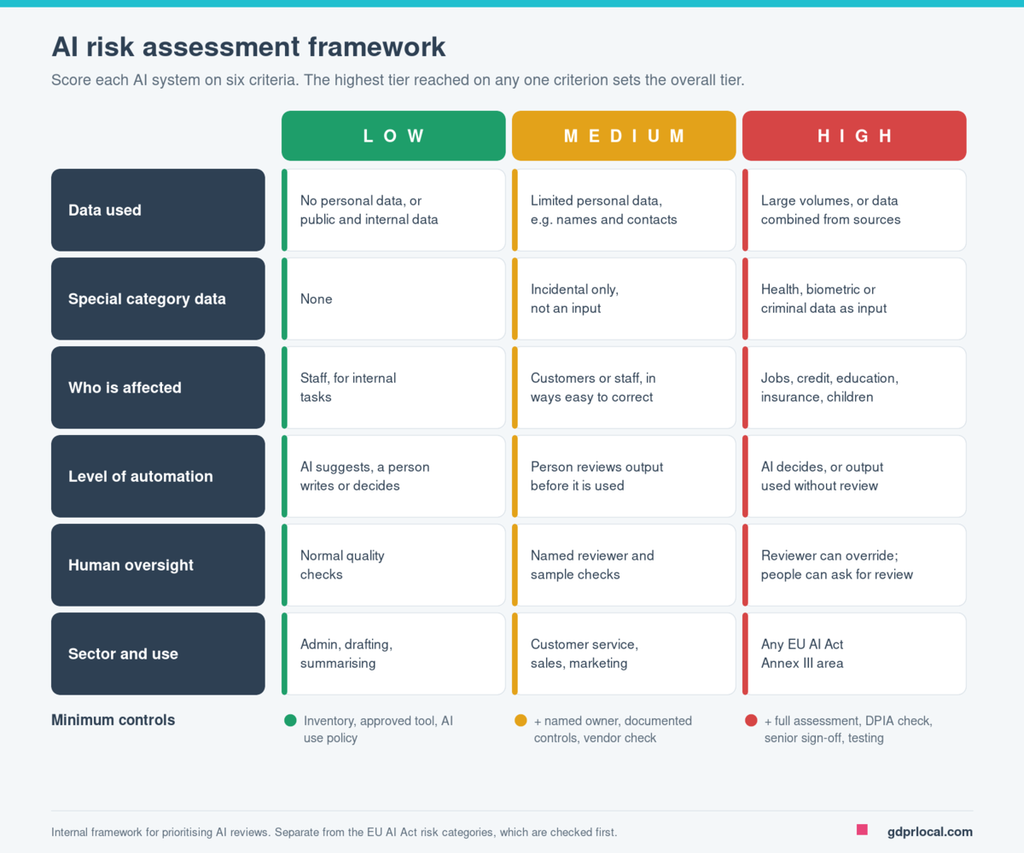
Score each AI system against the six criteria below. The highest tier reached on any single criterion sets the overall tier. A system that is low on five criteria and high on one is a high-tier system.
| Criterion | Low | Medium | High |
|---|---|---|---|
| Data used | No personal data, or public and internal business data only | Limited personal data, such as names and contact details of staff or customers | Large volumes of personal data, or personal data combined from several sources |
| Special category data | None | None as an input, though it may appear incidentally | Health, biometric or other special category data, or criminal offence data, used as an input |
| Who is affected | Staff using the tool for internal tasks | Customers or staff, in ways that are easy to notice and correct | Decisions about people’s jobs, education, credit, insurance or access to services, or use involving children or vulnerable people |
| Level of automation | The AI suggests, and a person writes or decides | The AI produces output that a person reviews before it is used | The AI decides, or its output is used without review |
| Human oversight | Normal quality checks are enough | A named reviewer and regular sample checks | A named reviewer with authority to override, and a way for affected people to ask for review |
| Sector and use | Internal administration, drafting, summarising | Customer service, sales and marketing that reaches people outside the company | Any area listed in Annex III of the AI Act |
Each tier then sets the minimum controls:
• Low: record the system in the AI inventory, confirm it is an approved tool, and apply the AI use policy. Review once a year.
• Medium: everything in the low tier, plus a named owner, documented controls for data and output quality, staff guidance for that tool, and a check of the vendor’s terms. Review every six months or when the tool changes.
• High: everything in the medium tier, plus a full written assessment of impacts on people, a check of AI Act and GDPR duties (including whether a DPIA is needed), sign-off by a senior owner, and testing or monitoring of outputs before and after launch. Review at least every six months and after any incident.
The review intervals are a starting point. Adjust them to the pace at which your tools and vendors change.
How to Run an AI Risk Assessment in 6 Steps
Step 1: Build the Inventory
List every AI system in use or in development, including AI features inside existing software. Record the purpose, business owner, vendor, data, and users.
Step 2: Classify Under the AI Act
Check Article 5 first, then Annex III, then whether transparency obligations apply. Record whether the company is the provider or the deployer of the system, because the duties differ.
Step 3: Assess the Impact
Score the system against the criteria table. Describe who could be harmed and how: an unfair decision, a disclosure of personal data, wrong information given to a customer, or an error that nobody notices.
Step 4: Set the Controls
Apply the minimum controls for the tier, then add controls for the specific risks found in Step 3. Examples include limiting the data the tool can access, requiring human review of certain outputs, logging decisions and adding contract terms with the vendor.
Step 5: Get Sign-Off
The business owner signs off low-tier systems. A senior owner signs off medium- and high-tier systems, with input from data protection and security. Record the decision, the date, and any attached conditions.
Step 6: Review
Set a review date. Bring it forward if the vendor changes its model or terms, the tool is used for a new purpose, an incident occurs, or the law changes.
The steps follow the same logic as the NIST AI Risk Management Framework, a voluntary framework organised around four functions: Govern, Map, Measure and Manage.
When You Also Need a DPIA Under the GDPR
An AI risk assessment does not replace a data protection impact assessment. Where an AI system processes personal data, Article 35 GDPR requires a DPIA before the processing starts if it is likely to result in a high risk to people’s rights and freedoms. Article 35(1) specifically mentions new technologies.
Article 35(3) lists three cases where a DPIA is required in particular:
• a systematic and extensive evaluation of personal aspects based on automated processing, including profiling, on which decisions with legal or similarly significant effects are based;
• large-scale processing of special category data or criminal offence data;
• systematic monitoring of a publicly accessible area on a large scale.
Many high-tier AI systems will meet one of these. Supervisory authorities also publish their own lists of processing that needs a DPIA (Article 35(4)).
The two assessments can share work. Article 35(7) requires a DPIA to contain at least a description of the processing and its purposes, an assessment of necessity and proportionality, an assessment of the risks to people, and the measures to address them. Much of that comes from the AI risk assessment. Where a data protection officer has been designated, the controller must seek their advice (Article 35(2)). Our guide to the data protection impact assessment covers the full process.
AI Risk Assessment Template Outline
A one-page record per AI system is enough for low-tier tools. High-tier systems need more detail under the same headings:
• System name, version and vendor
• Business owner and assessor
• Purpose and intended use
• Provider or deployer role under the AI Act
• AI Act classification and reasoning
• Data used, including personal and special category data
• People affected
• Level of automation and human oversight
• Criteria scores and overall tier
• Risks identified
• Controls required and owners
• DPIA needed (yes or no, with reasoning)
• Sign-off, date and conditions
• Review date and review triggers
Conclusion
An AI risk assessment gives each AI tool a clear rating, a set of controls and an owner. Classify under the AI Act first, use the low, medium and high tiers to decide how much internal scrutiny each tool needs, and run a DPIA where the GDPR requires one. Done consistently, the assessments give the company a record of what it uses and why it decided each use was acceptable.
AI risk management is one of the four pillars of GDPRLocal’s AI governance service, AIGo, which covers tailored risk assessment methodologies, AI risk and impact assessments, and third-party and incident management processes.
Frequently Asked Questions
Who Should Carry Out an AI Risk Assessment?
The business owner of the AI system usually leads it, because they know how the tool is used. Data protection, security and legal input is needed for medium- and high-tier systems, and a senior owner signs off.
Does Law require an AI Risk Assessment?
No single law requires an AI risk assessment for every AI tool. The EU AI Act requires providers of high-risk AI systems to run a risk management system (Article 9), and the GDPR requires a DPIA where processing is likely to result in a high risk. An internal AI risk assessment is how many companies show they have checked which of these duties apply.
How Often Should an AI Risk Assessment Be Reviewed?
On a schedule set by the tier, and sooner if something changes: a new vendor model or terms, a new use, an incident, or a change in the law. Article 35(11) GDPR also requires a DPIA review at least when the risk changes.
What Is the Difference Between an AI Risk Assessment and a DPIA?
An AI risk assessment covers any risk from an AI system, including errors, unfair outcomes and vendor issues, whether or not personal data is involved. A DPIA is a GDPR requirement that focuses on risks to people from the processing of their personal data.
Disclaimer: This blog post is intended solely for informational purposes. It does not offer legal advice or opinions. This article is not a guide for resolving legal issues or managing litigation on your own. It should not be considered a replacement for professional legal counsel and does not provide legal advice for any specific situation or employer.