EU AI Act Summary: Risk Categories + Compliance Checklist
The EU AI Act, formally known as Regulation (EU) 2024/1689, is the world’s first comprehensive legal framework for artificial intelligence. It entered into force on 1 August 2024 and sets rules across the European Union for developing, deploying, and using AI systems while protecting fundamental rights.
The EU Artificial Intelligence Act applies to all organisations that place AI systems on the EU market, regardless of location. This makes compliance essential for AI providers worldwide.
This article covers the AI Act’s risk-based classification system, compliance obligations for different stakeholder roles, and implementation timelines through 2026. The focus is on practical requirements rather than detailed legal analysis so that you can plan your compliance work now.
Non-compliance with the EU AI Act can result in fines of up to €35 million or 7% of global annual turnover, whichever is higher. Beyond penalties, the regulation determines market access across the EU’s roughly 450 million consumers.
If your organisation needs help with EU AI Act compliance, GDPRLocal can help.
Key takeaways:
• Four-tier risk classification system and how it applies to your AI systems.
• Specific compliance obligations for providers, deployers, and distributors.
• Implementation timeline with critical deadlines starting February 2025.
• Practical steps for conducting risk assessments and setting up governance.
What is the EU AI Act’s regulatory framework?
The EU AI Act sorts AI systems into four risk levels, each with its own compliance obligations. Different AI systems pose varying levels of risk to safety, fundamental rights, and democratic processes, so the rules should scale with that risk.
The regulation covers the entire AI value chain, from development through deployment and ongoing operation.
What counts as an AI system under the regulation?
The AI Act defines an AI system as software that, for explicit or implicit objectives, generates outputs such as predictions, recommendations, or decisions that influence physical or virtual environments. This definition covers machine learning models, neural networks, and rule-based systems.
General-purpose AI models receive separate treatment under the regulation because of their broad capabilities and potential systemic risks. These models, including large language models, are trained on large datasets and can perform a wide range of tasks.
The regulation distinguishes between three roles in the AI value chain: providers who develop or substantially modify AI systems, deployers who use AI systems for their intended purpose, and distributors who make AI systems available on the EU market.
How does the four-tier risk structure work?
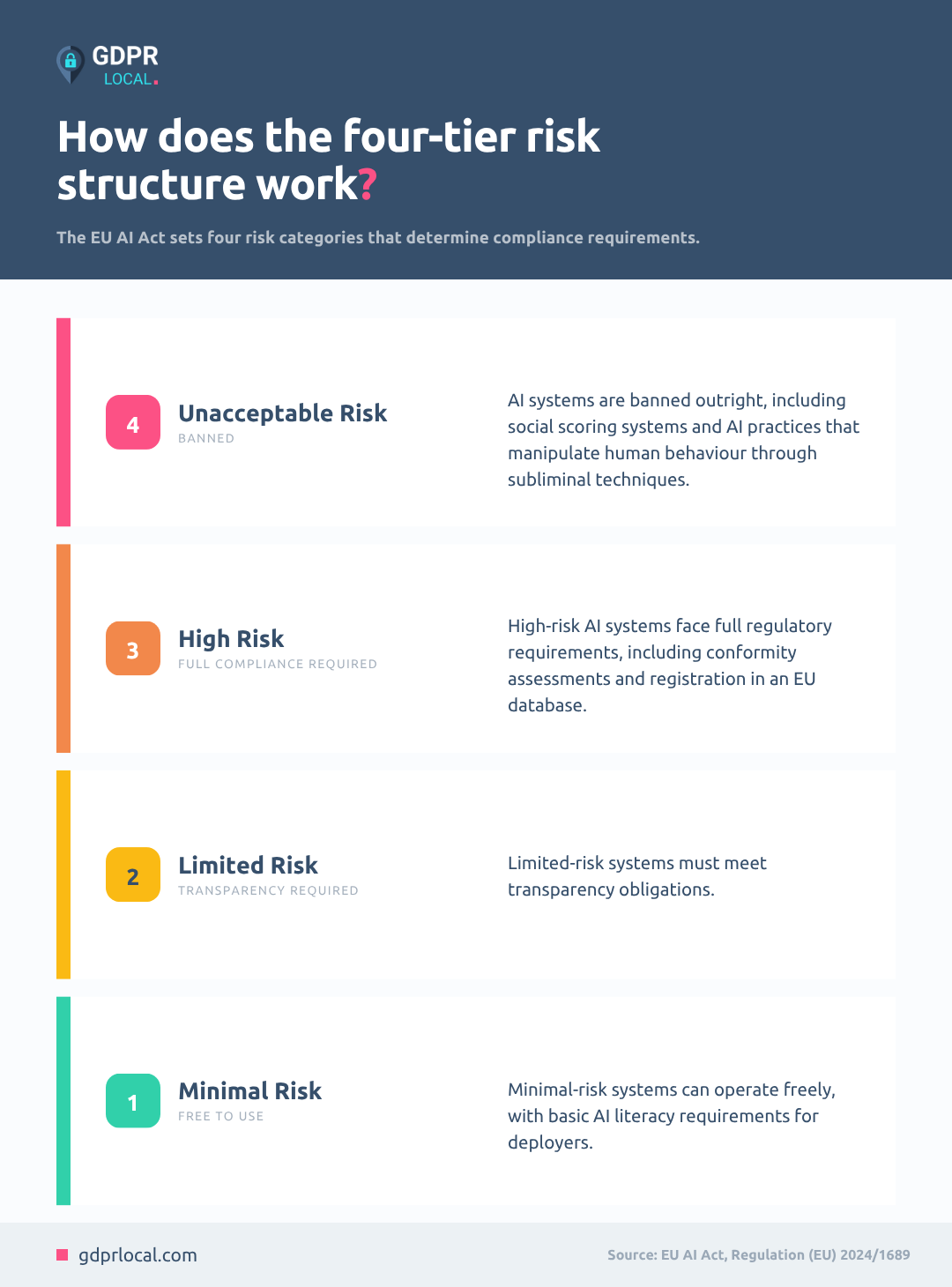
The EU AI Act sets four risk categories that determine compliance requirements:
• Unacceptable risk: AI systems are banned outright, including social scoring systems and AI practices that manipulate human behaviour through subliminal techniques.
• High-risk AI systems face full regulatory requirements, including conformity assessments and registration in an EU database.
• Limited-risk systems must meet transparency obligations.
• Minimal-risk systems can operate freely, with basic AI literacy requirements for deployers.
What are the AI Act’s system classifications and requirements?
The practical impact of the EU AI Act depends on how your AI systems fall within the four-tier risk framework. Obligations range from a full ban to minimal transparency requirements.
Which AI systems are prohibited under unacceptable risk?
Eight specific AI practices are banned under the EU AI Act, effective 2 February 2025. These include social scoring systems used by public authorities, AI systems that use subliminal techniques to manipulate behaviour, and specific AI systems for emotion recognition in workplace and educational settings.
Real-time remote biometric identification in publicly accessible spaces is generally prohibited too, with narrow exceptions for law enforcement in cases involving serious crimes, subject to judicial authorisation and specific safeguards.
Organisations must immediately discontinue the use of any prohibited AI systems and remove them from the EU market, regardless of their current operational status.
What obligations apply to high-risk AI systems?
High-risk AI systems operate in safety-critical sectors or in the specific use cases listed in Annex III of the regulation. Common examples include AI systems used for hiring and personnel management, credit scoring and loan decisions, critical infrastructure management, and border control.
These systems must undergo third-party conformity assessment before market entry, keep detailed technical documentation, and be registered in the official EU database. Providers must establish robust risk management systems and ensure proper human oversight throughout the AI system’s lifecycle.
Key compliance requirements:
• Pre-market conformity assessment and CE marking.
• Registration in the EU database within specified timeframes.
• Continuous post-market monitoring and serious incident reporting.
• Quality management system implementation and maintenance.
High-risk AI system deployers must also conduct fundamental rights impact assessments and ensure that personnel involved in system operation and oversight have adequate AI literacy.
What rules apply to limited-risk and minimal-risk AI?
Limited-risk systems, mainly chatbots and AI-generated content tools, must meet transparency obligations to inform users they’re interacting with AI. These systems must clearly disclose when a person is dealing with artificial intelligence rather than another human.
Most AI systems fall into the minimal-risk category, including spam filters, AI-enabled video games, and basic recommendation systems. These systems face no extra regulatory requirements beyond general EU law. Organisations still need to make sure relevant staff meet AI literacy obligations.
What is the EU AI Act’s implementation timeline?
The EU AI Act follows a phased rollout. This gives organisations time to adapt while the most critical protections take effect quickly for the highest-risk applications.
What are the key implementation dates?
When to use this: compliance planning and regulatory preparation across all organisational levels.
1. 1 August 2024: The EU AI Act entered into force, setting up the legal framework and institutional structure, including the European AI Office and the AI Board.
2. 2 February 2025: Prohibited AI systems must be discontinued, and AI literacy obligations take effect for all organisations deploying AI systems in the European Union.
3. 2 August 2025: General-purpose AI model providers must meet transparency requirements, including disclosure of copyrighted training data and technical documentation for models with systemic risk.
4. 2 August 2026: Full applicability for high-risk AI systems, including complete conformity assessment requirements, EU database registration, and full quality management system implementation.
How do provider and deployer obligations compare?
| Responsibility Area | AI System Providers | AI System Deployers |
| Conformity Assessment | Conduct before market placement | Verify completion and validity |
| EU Database Registration | Register high-risk systems | Monitor compliance status |
| Risk Management | Develop and maintain the system | Implement operational procedures |
| Impact Assessments | Technical risk evaluation | Fundamental rights assessment |
Deployers bear primary responsibility for ensuring AI systems are used appropriately and monitored within their specific operational context. Providers focus on technical compliance and system design.
Organisations often fulfil multiple roles at once. This means you need a clear picture of overlapping obligations and shared responsibilities across the AI value chain.
What common challenges come up during AI Act compliance?
Organisations working on AI Act compliance encounter predictable hurdles in risk assessment, role identification, and timeline management. Here’s how to work through them.
1. How do you determine an AI system’s risk classification?
Run a systematic assessment using the Annex III checklist, combined with an intended-use-case analysis and a fundamental-rights impact evaluation.
Many AI systems operate across multiple contexts. This calls for a careful look at each specific deployment scenario rather than broad assumptions based on the type of technology.
2. How do you identify your role in the value chain?
Map all your AI development, deployment, and distribution activities to the roles defined in the regulation. Organisations frequently act in more than one capacity at the same time.
Document decision-making authority, technical modification capabilities, and market-facing responsibilities to work out your primary and secondary obligations under the AI Act.
3. How should you prepare for compliance deadlines?
Use a phased approach. Start with an immediate review of prohibited systems, then set up a governance framework, and work systematically towards each applicable deadline.
Prioritise actions based on the AI system’s risk level and your organisation’s readiness. Give critical compliance dates enough preparation time and resources.
Conclusion
The EU AI Act is the first regulatory framework to require advance compliance planning, rather than a reaction to enforcement action. Organisations must adapt their AI governance, documentation, and operational procedures to meet requirements that continue to expand through 2026.
Frequently Asked Questions
What types of AI systems are prohibited under the EU AI Act?
The EU AI Act prohibits AI systems that pose unacceptable risks. This includes social scoring systems by public authorities, AI systems that manipulate human behaviour through subliminal techniques, and real-time remote biometric identification systems in publicly accessible spaces, except in narrowly defined law enforcement scenarios with proper human review and judicial authorisation.
How does the EU AI Act classify high-risk AI systems?
High-risk AI systems are those used in safety-critical sectors or specific use cases listed in Annex III of the regulation, such as hiring processes, credit scoring, critical digital infrastructure management, and border control. These systems must undergo third-party conformity assessment, be registered in the EU database, and implement risk management systems along with human oversight.
What are the compliance timelines for the EU AI Act?
The EU AI Act came into force on 1 August 2024. Key deadlines include 2 February 2025 for discontinuing prohibited AI systems and implementing AI literacy obligations; 2 August 2025 for general-purpose AI model transparency requirements; and 2 August 2026 for the full applicability of high-risk AI system compliance requirements, including conformity assessments and EU database registration.

About the Author
Head of Commercial & Country Manager
Zlatko Delev is Head of Commercial and Country Manager at GDPRLocal, where he leads the company’s commercial strategy and market presence. He brings international experience across sales, marketing, and customer success, along with a legal background from his studies at Iustinianus Primus Law School in Skopje, Macedonia.
Zlatko sits at the front line of GDPRLocal’s client relationships, guiding organisations through the first stages of their compliance journey and helping them understand where they stand and where they need to go on GDPR, information security, and the emerging landscape of AI regulation. His role bridges commercial strategy with practical data protection knowledge, ensuring clients get clear, actionable direction from their very first conversation with GDPRLocal.
Alongside his commercial focus, Zlatko has trained extensively in project management and organisational leadership, including risk management, stakeholder communication, agile methodology, and digital marketing, a broad skill set that supports his structured, delivery-focused approach to growing GDPRLocal’s business internationally.