GDPR Employee Monitoring: Compliance Considerations for Employers
Employee monitoring is now a common practice in the digital workplace. Employers use a range of technologies, including internet tracking, video and audio surveillance, and call monitoring, to manage performance, ensure security, and oversee productivity. Monitoring software is also frequently used to maintain compliance. However, the General Data Protection Regulation (GDPR) introduces complex legal requirements that organisations must comply with when monitoring their staff.
Key Takeaways
• Employee monitoring must strike a balance between legitimate business interests and employees’ data protection rights under the GDPR.
• Transparency, lawful basis, and data minimisation are essential principles for compliant monitoring practices.
• Conducting Data Protection Impact Assessments (DPIAs) and legitimate interest assessments helps mitigate privacy risks and ensure compliance.
What is employee monitoring and what forms does it take?
Employee monitoring is the systematic tracking of employee activities in the workplace using various tools and technologies. This practice has grown significantly with the rise of digital workplaces and remote working arrangements, especially as remote work and remote monitoring have become central to how organisations manage productivity and compliance.
Standard employee monitoring practices include:
• Tracking internet usage and website visits
• Monitoring email communications and other digital correspondence
• Recording phone calls and tracking phone usage
• Video surveillance of workplace areas
• Keystroke monitoring and screen capture
• Location tracking via mobile devices
• Monitoring application usage and productivity metrics
• Biometric data collection for access control
While these monitoring practices can serve legitimate business purposes, the GDPR sets strict parameters for how such activities can be conducted. The regulation requires that any form of monitoring respect employees’ fundamental privacy rights while allowing employers to pursue their legitimate interests.
According to the Information Commissioner’s Office (ICO), employers must ensure that monitoring is proportionate, transparent, and necessary. Simply having the technical capability to monitor staff doesn’t automatically give organisations the legal right to do so.
What does data protection law require for employee monitoring?
Data protection law establishes a framework that balances employers’ legitimate needs for monitoring with employees’ fundamental right to privacy. The GDPR and national legislation, such as the Data Protection Act, set out specific rules governing how organisations may process personal data, including data collected through monitoring activities. Employers must also comply with all relevant regulations governing employee monitoring to ensure legal compliance and protect workers’ rights to privacy.
Key principles of data protection law that apply to employee monitoring include:
1. Lawfulness, fairness, and transparency: Employers must have a legal basis for monitoring and be transparent with employees about their monitoring practices.
2. Purpose limitation: Data collected through monitoring may be used only for specified, explicit, and legitimate purposes.
3. Data minimisation: Only the minimum amount of data necessary for the stated purpose should be collected.
4. Accuracy: Data must be kept accurate and up to date.
5. Storage limitation: Data should not be kept longer than necessary.
6. Integrity and confidentiality: Appropriate security measures must be implemented to uphold these principles.
7. Accountability: Employers must be able to demonstrate compliance with data protection principles.
Understanding these principles is essential for any organisation implementing workplace monitoring. The GDPR doesn’t prohibit employee monitoring outright, but it does require that such monitoring be conducted in a way that respects these foundational principles. Guidance from the ICO (Information Commissioner’s Office, the UK regulatory authority for data protection) is also important for ensuring compliance with the latest standards and instructions.
How can employers ensure data protection compliance?
Achieving data protection compliance for employee monitoring requires a structured approach and careful planning. Lawful practices must be followed when monitoring staff to ensure compliance with data protection regulations and maintain transparency.
When must employers conduct a Data Protection Impact Assessment?
Before implementing any new employee monitoring system, organisations should conduct a data protection impact assessment (DPIA). This is a mandatory requirement under the GDPR for processing activities that are likely to pose a high risk to individuals’ rights and freedoms.
Employee monitoring is typically considered high-risk processing because it involves the systematic monitoring of individuals and may involve the capture of special category data. A thorough DPIA helps identify and mitigate these risks before they materialise.
A DPIA for employee monitoring should include:
• A systematic description of the monitoring activities
• Assessment of necessity and proportionality
• Identification of risks to employees’ rights and freedoms
• Measures to address those risks
The DPIA process helps ensure that monitoring is implemented in a way that minimises privacy intrusions while still meeting legitimate business needs.
What lawful basis should employers use for employee monitoring?
Every instance of employee monitoring must be supported by an appropriate lawful basis under GDPR. The six lawful bases are:
1. Consent
2. Contract
3. Legal obligation
4. Vital interests
5. Public interest
6. Legitimate interests
In the employment context, consent is generally problematic due to the power imbalance between employers and employees. As the European Data Protection Board notes, employees may feel unable to refuse consent due to their dependency on the employer.
Instead, most organisations rely on legitimate interests or legal obligation as the lawful basis for employee monitoring:
• Legitimate interests: When monitoring serves purposes such as security, protection of business information, ensuring productivity, or crime prevention. This requires conducting a legitimate-interest assessment to balance the employer’s legitimate interests against employees’ privacy rights.
• Legal obligation: When monitoring is required by law, such as in regulated industries where certain communications must be recorded.
When relying on legitimate interests, employers must conduct and document a legitimate interest assessment that:
• Identifies the specific legitimate interest
• Demonstrates why monitoring is necessary to achieve that interest
• Balances this against employee privacy rights
What must employers tell employees about monitoring?
Transparency is a fundamental requirement of data protection compliance. Employees must be informed about:
• What monitoring is taking place
• Why monitoring is necessary
• How the data will be used
• Who will have access to the data
• How long the data will be retained
This information should be provided in privacy notices that are easily accessible to employees. Many organisations include this information in employee handbooks and specific monitoring policies.
Beyond meeting legal requirements, transparency builds trust with employees and reduces the risk of monitoring being perceived as intrusive or unfair.
What do GDPR’s core principles mean for employee monitoring?
The GDPR establishes specific requirements that directly impact employee monitoring practices. Understanding these provisions is important for compliance, particularly in the context of GDPR considerations in the healthcare sector.
• Integrity and confidentiality: Employers must implement appropriate security measures to protect personal data, including restricting access to personal data only to authorised personnel. This helps ensure data is not accessed, altered, or disclosed unlawfully.
How do GDPR’s core principles apply to monitoring data?
Article 5 of the GDPR outlines the fundamental principles for processing personal data, all of which apply to employee monitoring:
• Lawfulness, fairness, and transparency: Monitoring must be conducted in a lawful, fair, and transparent manner.
• Purpose limitation: Data collected through monitoring can only be used for the specific purposes that were disclosed to employees.
• Data minimisation: Only collect what is necessary for your stated purposes. For example, if monitoring internet usage to ensure security, you may not need to capture the content of all communications.
• Accuracy: Ensure that monitoring data is accurate and kept up to date. Inaccurate data could lead to unfair treatment of employees.
• Storage limitation: Establish clear retention periods for monitoring data and delete it when no longer needed.
• Integrity and confidentiality: Implement appropriate security measures to protect monitoring data from unauthorised access or breach.
What data subject rights do employees have regarding monitoring?
Under the GDPR, employees retain their rights as data subjects, including:
• Right to be informed: Employees must be informed about monitoring activities.
• Right of access: Employees can make a data subject access request to obtain copies of data collected through monitoring.
• Right to rectification: If monitoring data is inaccurate, employees have the right to request that it be corrected or updated.
• Right to erasure: In certain circumstances, employees can request the deletion of monitoring data.
• Right to restrict processing: Employees can request that their data not be used in specific ways.
• Right to data portability: Employees may have the right to obtain and reuse their data.
• Right to object: Employees can object to processing based on legitimate interests.
• Rights related to automated decision making: Protection against purely automated decisions with significant effects.
Organisations must establish procedures to handle these rights requests effectively when they relate to monitoring data.
What is the lawful basis for employee monitoring under GDPR?
Selecting the appropriate lawful basis for employee monitoring is one of the most important compliance decisions an organisation will make. This choice affects the rights available to employees and the obligations that employers have. Failing to select an appropriate lawful basis can result in unlawful monitoring, which may lead to legal disputes, unfair dismissal claims, and discrimination claims under employment law.
Why is consent problematic as a lawful basis for employee monitoring?
While consent might seem like a straightforward option, it’s generally problematic in the employment context. The GDPR requires that consent be:
• Freely given
• Specific
• Informed
• Unambiguous
Due to the inherent power imbalance in the employer-employee relationship, regulators have questioned whether employee consent can truly be “freely given.” Employees may fear negative consequences for refusing to consent, making it challenging to establish valid consent under the GDPR.
As the European Data Protection Board notes: “Due to the dependency that results from the employer/employee relationship, it is unlikely that the data subject can deny his/her employer consent to data processing without experiencing fear or real risk of detrimental effects.”
How should employers apply the legitimate interests test?
For most workplace monitoring scenarios, legitimate interests provide a more appropriate lawful basis. However, this requires a careful balance between the employer’s legitimate interests and employees’ rights and freedoms.
When conducting a legitimate interest assessment, consider:
1. Purpose test: Is there a legitimate interest behind the monitoring?
2. Necessity test: Is monitoring necessary to achieve this purpose, or could the same goal be achieved through less invasive means?
3. Balancing test: Do the individual’s interests, rights, or freedoms override the legitimate interest?
Legitimate interests that might justify monitoring include:
• Ensuring the security of company systems and data
• Preventing fraud or misconduct
• Ensuring compliance with legal obligations
• Managing productivity and performance
• Protecting the company’s position
However, even when a legitimate interest exists, monitoring must still be proportionate and respect employee privacy.
When can legal obligation justify employee monitoring?
In some sectors, monitoring may be required by law or regulation. For example:
• Financial services firms may need to record certain communications
• Organisations with health and safety requirements may need to monitor compliance
• Public sector bodies may have specific legal obligations
When relying on a legal obligation as the lawful basis, ensure that you identify the specific legal provision that requires the monitoring.
When is covert employee monitoring permitted under GDPR?
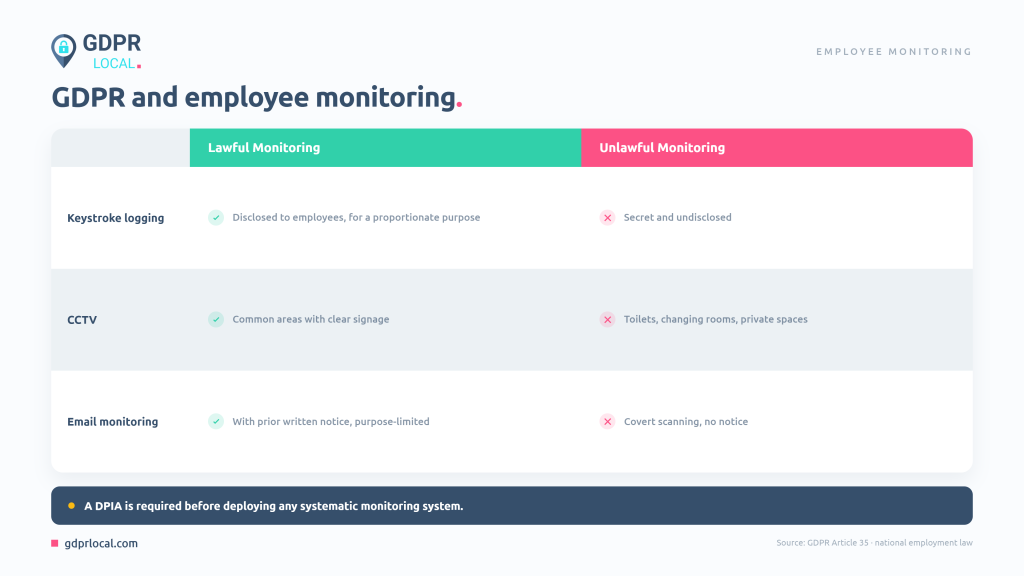
Covert monitoring, or monitoring employees without their knowledge, is considered particularly high risk under data protection law. Such practices include keystroke monitoring without notification, the use of hidden cameras, and secret email monitoring.
The ICO guidance emphasises that covert monitoring should only be conducted in exceptional circumstances, such as:
• When there is reason to suspect criminal activity or serious malpractice
• When notifying employees about the monitoring would prejudice its prevention or detection
• When the monitoring is strictly limited in scope and time
Even in these exceptional circumstances, organisations should:
• Document the decision to undertake covert monitoring and the justification
• Limit the monitoring to specific individuals under suspicion rather than all employees
• Restrict the period of covert monitoring
• Limit access to the results to a small number of authorised individuals
• Conduct a DPIA before proceeding
Outside of these exceptional cases, covert monitoring practices are likely to be considered unlawful under the GDPR due to their inherent lack of transparency.
What data collection and storage rules apply to employee monitoring?
How organisations collect, use, and store data obtained through employee monitoring, such as video surveillance data, is important for GDPR compliance.
How does data minimisation apply to employee monitoring?
The principle of data minimisation requires that organisations collect only the data necessary to achieve the specified purpose. For example:
• If monitoring internet usage to ensure security, collect data on sites visited rather than capturing entire browsing sessions
• If tracking productivity, measure time spent on relevant applications rather than recording all screen content
• If monitoring email for compliance, use keyword scanning rather than reading all content
Organisations should configure their monitoring systems to collect only what is necessary, rather than relying on default settings that may capture excessive data.
How long can employers keep employee monitoring data?
Clear retention policies must be established for data collected by monitoring systems to ensure compliance with applicable regulations and maintain data integrity. These policies should specify:
• How long will different types of monitoring data be kept
• The justification for the chosen retention period
• How data will be securely deleted at the end of the retention period
The GDPR requires that personal data be kept for no longer than necessary for the purposes for which it was processed. This means that monitoring data should not be retained indefinitely “just in case” it might be needed.
What security measures are required for employee monitoring data?
Given the sensitive nature of employee monitoring data, strong security measures are essential. These should include:
• Encryption of monitoring data both in transit and at rest
• Strong access controls limiting who can view monitoring data
• Authentication measures to prevent unauthorised access
• Regular security assessments of monitoring systems
• Procedures for handling data breaches
Senior management should be involved in determining who has access to monitoring data, with access restricted to those who genuinely require it.
What does GDPR require for automated decision-making in monitoring?
Monitoring systems are increasingly incorporating elements of automated decision-making, such as productivity scoring or automatic flagging of potential policy violations. The GDPR contains specific provisions governing these practices, notably under Article 22, which restricts the use of solely automated decisions that produce legal or similarly significant effects on individuals without meaningful human involvement.
Employers must ensure that any automated decision-making processes used for employee monitoring do not adversely affect employees’ rights, and that appropriate safeguards are in place. This includes providing employees with the right to obtain a human review of decisions, to express their views, and to contest decisions made solely by automated means.
To comply with GDPR requirements, organisations should:
• Inform employees about the use of automated decision-making in monitoring activities.
• Ensure that automated systems are transparent, fair, and subject to regular audits and review.
• Implement mechanisms for human intervention to review and override automated decisions when necessary.
• Avoid making significant employment decisions, such as disciplinary actions or pay adjustments, solely based on automated monitoring outputs without human oversight.
By addressing these requirements, employers can use the benefits of monitoring software while respecting data protection principles and maintaining employee trust.
What are the best practices for GDPR-compliant employee monitoring?
To achieve GDPR-compliant employee monitoring, employers should adopt a series of best practices that balance business interests with employee privacy rights. Below are key points to consider for effective and compliant employee monitoring:
1. Conduct thorough risk assessments: Before implementing monitoring systems, perform Data Protection Impact Assessments (DPIAs) to identify and mitigate significant risks associated with processing employee data.
2. Use monitoring software responsibly: Select employee monitoring software that minimises data collection to what is necessary and supports privacy-by-design and privacy-by-default principles.
3. Ensure transparency and communication by providing employees with precise, accessible information about the monitoring purposes, methods, and data-handling procedures, ideally through employee handbooks and privacy notices.
4. Limit data retention: Establish and adhere to strict data retention policies to avoid holding employee data longer than necessary.
5. Restrict access to monitoring data: Implement strong security measures and limit access to authorised personnel only.
6. Engage in collective bargaining agreements where applicable: In some jurisdictions, employee representatives must be consulted before introducing monitoring systems to ensure compliance with relevant labour laws.
7. Regularly review and update monitoring practices to stay current with new technologies and legal developments, ensuring ongoing compliance with relevant regulations.
By following these practices, organisations can create a monitoring environment that protects privacy and supports effective performance management.
Conclusion
GDPR employee monitoring requires a careful balance between business needs and employee privacy rights. By conducting thorough risk assessments, ensuring transparency, selecting appropriate monitoring software, and maintaining strong security measures, employers can comply with data protection laws while protecting employee rights. Incorporating human oversight in automated decision-making and engaging with employee representatives further supports compliance and trust. Proactive adherence to these principles helps organisations manage workplace monitoring responsibly and effectively.
Frequently Asked Questions
Is employee monitoring allowed under GDPR?
Yes, employee monitoring is permitted under GDPR as long as it complies with key principles such as lawfulness, transparency, proportionality, and data minimisation. Employers must have a valid and lawful basis, and respect employees’ rights to data protection.
When is covert monitoring justified?
Covert monitoring is only justified in exceptional circumstances, such as when there is suspicion of criminal activity or serious misconduct, where informing employees beforehand would compromise the investigation. It must be strictly limited in scope and duration and documented through a Data Protection Impact Assessment.
Can automated decision-making be used in employee monitoring?
Automated decision-making can be used, but it must not produce legal or similarly significant effects on employees without meaningful human intervention. Employees have the right to request human review and to challenge decisions made solely by automated processes.

About the Author
Zlatko Delev
Country Manager & Head of Commercial — GDPRLocal
Zlatko specialises in data protection compliance, ISMS strategy, and AI law. With a legal background and hands-on experience supporting organisations globally, he helps businesses navigate GDPR, the EU AI Act, and international privacy frameworks.

About the Author
Head of Commercial & Country Manager
Zlatko Delev is Head of Commercial and Country Manager at GDPRLocal, where he leads the company’s commercial strategy and market presence. He brings international experience across sales, marketing, and customer success, along with a legal background from his studies at Iustinianus Primus Law School in Skopje, Macedonia.
Zlatko sits at the front line of GDPRLocal’s client relationships, guiding organisations through the first stages of their compliance journey and helping them understand where they stand and where they need to go on GDPR, information security, and the emerging landscape of AI regulation. His role bridges commercial strategy with practical data protection knowledge, ensuring clients get clear, actionable direction from their very first conversation with GDPRLocal.
Alongside his commercial focus, Zlatko has trained extensively in project management and organisational leadership, including risk management, stakeholder communication, agile methodology, and digital marketing, a broad skill set that supports his structured, delivery-focused approach to growing GDPRLocal’s business internationally.