Understanding PIPEDA: Canada’s Federal Privacy Law
Updated: August 2026
In this blog, we’ll explore the Personal Information Protection and Electronic Documents Act (PIPEDA). We’ll explain what PIPEDA is, who it affects, and its main principles. You’ll also learn about the rights it grants to individuals and the obligations it places on businesses. Our goal is to help you understand how to comply with the regulation and why protecting personal information matters in a business environment.
If you need help understanding PIPEDA requirements, you’re in the right place.
Key Takeaways
• PIPEDA is Canada’s federal law governing how private-sector organisations handle personal information in commercial activities. It applies to federally regulated industries across Canada, to businesses in provinces without a “substantially similar” privacy law (currently everywhere except British Columbia, Alberta, and Quebec), and to any personal information that crosses provincial or international borders, regardless of where the business is based.
• PIPEDA’s data subject rights differ from GDPR’s in some important ways: there’s no explicit right to erasure (only a requirement to destroy, erase, or anonymise data once it’s no longer needed) and no right to data portability, though individuals do have rights to access, correction, and withdrawal of consent.
• Non-compliance already carries real consequences: the Office of the Privacy Commissioner of Canada can investigate, publish reports on non-compliant businesses, and refer serious cases to the Federal Court, which can order changes to business practices and award damages.
What is PIPEDA?
The Personal Information Protection and Electronic Documents Act (PIPEDA) is a key Canadian law that regulates how private-sector organisations handle personal information during commercial activities. Established in the early 2000s, PIPEDA requires businesses to manage personal data with stringent privacy and security standards, irrespective of whether it’s collected, used, or disclosed within Canada.
PIPEDA emphasises individual control over personal information. It mandates clear guidelines for businesses, including securing consent for data use, providing data access upon request, and ensuring secure storage and proper disposal of personal data.
Who does PIPEDA apply to?
PIPEDA governs a wide array of entities and how they process personal information, including:
Federally regulated businesses – This means that organisations operating across provincial borders in sectors like banking, telecommunications, airlines, and railways must comply with PIPEDA when managing both consumer and employee personal data.
Businesses in provinces without similar privacy laws – In provinces that haven’t enacted their own “substantially similar” privacy legislation (currently excluding British Columbia, Alberta, and Quebec), PIPEDA sets the standard for how businesses must collect, use, and disclose personal information during commercial activities.
Information that crosses borders – Every company in Canada that handles personal information crossing provincial or international lines for commercial activities must comply with PIPEDA. This applies across Canada, even in provinces with their own privacy laws.
Who is Exempt?
While PIPEDA’s scope is extensive, certain exemptions are noteworthy:
– Federal government departments and agencies are generally exempt from PIPEDA. They operate under a separate law called the Privacy Act, which sets out similar, but not identical, privacy rules for the public sector.
– Employee personal information is handled in the context of an employment relationship. While PIPEDA strongly protects consumer data, it generally doesn’t cover how employers manage employees’ personal information. This includes details necessary for hiring, payroll, benefits, and performance management. Provinces may have separate rules on employee privacy.
– Data collected for personal, journalistic, or artistic purposes. This exemption helps protect individual privacy and freedom of expression.
The 10 Fair Information Principles
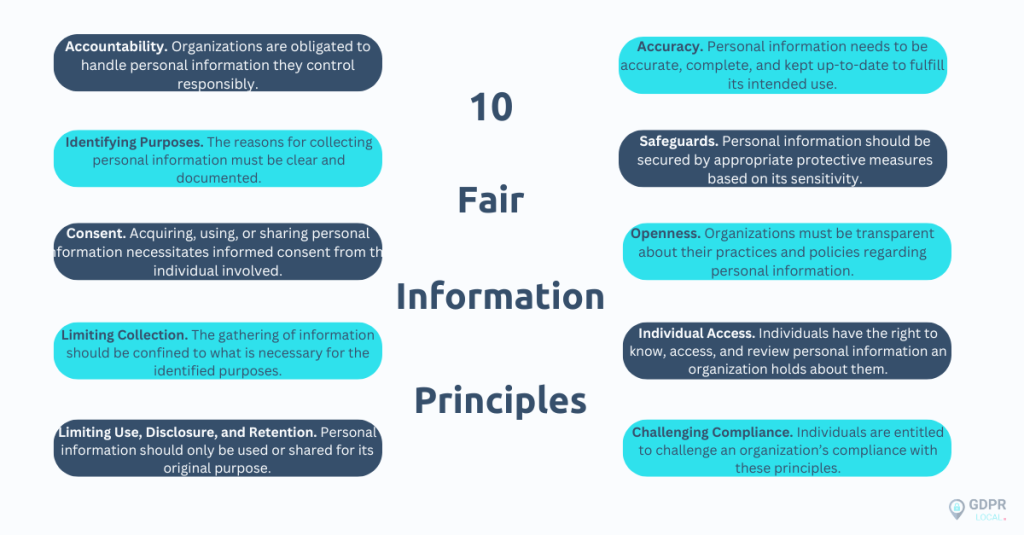
PIPEDA establishes ten essential principles that guide the protection and handling of personal information:
Rights of Data Subjects under PIPEDA
The Right to Erasure
PIPEDA does not grant individuals a direct right to erasure. Instead, it requires organisations to destroy, erase, or anonymise personal information that is no longer necessary for the purposes for which it was originally collected. Under PIPEDA, organisations must establish guidelines and implement procedures to manage the destruction of personal information.
Right to Amend Information
If an individual can prove that an organisation’s personal information is inaccurate or incomplete, PIPEDA gives them the right to correct it. This could involve correcting, deleting, or adding information. Crucially, any amendments must also be communicated to any third parties with access to the incorrect data.
Right to be Informed
From the moment of collection, individuals should be clearly informed about the purposes for which their data is being collected, either in writing or orally, depending on the circumstances. PIPEDA requires individuals to knowingly and voluntarily consent to using their personal information for stated purposes.
Right to Object/Right to Withdraw Consent
Under PIPEDA, individuals can withdraw consent at any time, provided they meet any legal or contractual obligations and give reasonable notice. Organisations must clarify the consequences of withdrawing consent. Nonetheless, organisations may keep the data for as long as needed to achieve the original purpose of collection.
Right of Access
PIPEDA gives individuals the right to ask whether an organisation holds their personal information and how it is used and disclosed. Organisations must provide access to this information when requested. However, exceptions exist, such as when the information could disclose someone else’s personal details or is covered by attorney-client privilege. Organisations must reply to these requests within 30 days, but this timeframe may be extended under certain conditions.
Right to Data Portability
Unlike some privacy regulations globally, PIPEDA does not explicitly provide a right to data portability—that is, the right to move one’s data from one service provider to another.
Do I need to comply with PIPEDA?
You must comply with PIPEDA if your organisation collects, uses, or discloses personal information during commercial activities in Canada. This applies whether you’re based in Canada, as long as you handle the data of Canadian residents. PIPEDA applies to federally regulated industries like banking, telecommunications, and transportation, regardless of provincial laws. Even if you operate in a province with its own privacy legislation, such as Quebec, Alberta, or British Columbia, PIPEDA still applies to interprovincial and international data transfers. If your business deals with Canadian consumers or clients and handles their personal information, PIPEDA compliance is crucial.
How to Ensure Compliance With PIPEDA
To remain compliant with PIPEDA:
– Adhere to the 10 Fair Information Principles. Ensure your organisation implements and maintains policies and procedures that meet these principles’ requirements.
– Ensure Mechanisms are in Place for Data Subjects to Exercise Their Rights. Set up accessible and efficient systems that allow individuals to access, correct, and control how their personal information is used.
– Establish Procedures for Handling Privacy Breaches. Develop and implement protocols to respond swiftly to any privacy breaches. This should include clear methods for detecting, reporting, and mitigating breaches both internally and to external authorities as mandated by PIPEDA.
What are the penalties if you don’t comply with PIPEDA?
Your organisation could face serious consequences if it fails to comply with PIPEDA. The Office of the Privacy Commissioner of Canada (OPC) can launch investigations and issue public reports detailing your non-compliance, which can damage your reputation.
In serious violations, the OPC can refer the matter to the Federal Court, which may order your organisation to change its practices and award damages to affected individuals. Proposed legislative updates could also impose financial penalties of up to $10 million CAD or 3% of global revenue, whichever is higher.
How We Can Assist
Our privacy experts at GDPRLocal can provide customised solutions to help your business comply with PIPEDA and build a reputation that sets you apart from the competition. By prioritising privacy, you enhance consumer trust, safeguard your brand, and reduce the risk of expensive penalties.
Contact us today for a consultation; we’ll help you create accurate privacy notices and develop compliant data collection and handling systems.
Frequently Asked Questions
Who does PIPEDA apply to?
Any organisation that collects, uses, or discloses personal information during commercial activities in Canada, whether or not the organisation itself is based in Canada. This includes federally regulated businesses in sectors like banking, telecommunications, and transportation across the country, businesses in provinces without a comparable privacy law, and any business whose data crosses provincial or international lines.
Is employee personal information covered by PIPEDA?
Generally, no. PIPEDA focuses on consumer data and doesn’t typically cover personal information handled in the context of an employment relationship, such as hiring, payroll, benefits, or performance management records, though individual provinces may have their own rules on employee privacy.
Does PIPEDA give individuals a right to erasure?
Not directly. Instead, it requires organisations to destroy, erase, or anonymise personal information once it’s no longer needed for the purpose it was originally collected for, and to have procedures in place for managing that destruction.
What happens if a business doesn’t comply with PIPEDA?
The Office of the Privacy Commissioner of Canada can investigate and publish reports on non-compliance, which carries reputational risk. For serious violations, the OPC can refer the matter to the Federal Court, which can order changes to the organisation’s practices and award damages to affected individuals.

About the Author
Head of Commercial & Country Manager
Zlatko Delev is Head of Commercial and Country Manager at GDPRLocal, where he leads the company’s commercial strategy and market presence. He brings international experience across sales, marketing, and customer success, along with a legal background from his studies at Iustinianus Primus Law School in Skopje, Macedonia.
Zlatko sits at the front line of GDPRLocal’s client relationships, guiding organisations through the first stages of their compliance journey and helping them understand where they stand and where they need to go on GDPR, information security, and the emerging landscape of AI regulation. His role bridges commercial strategy with practical data protection knowledge, ensuring clients get clear, actionable direction from their very first conversation with GDPRLocal.
Alongside his commercial focus, Zlatko has trained extensively in project management and organisational leadership, including risk management, stakeholder communication, agile methodology, and digital marketing, a broad skill set that supports his structured, delivery-focused approach to growing GDPRLocal’s business internationally.