Biometric Data GDPR Compliance Made Simple
Updated: March 2026
Curious about how GDPR treats biometric data? This guide covers everything from definitions and legal bases to breach response and emerging regulations. If your organisation collects fingerprints, facial images, or voice recordings, GDPR compliance is not optional.
Key Takeaways
• Biometric data is a special category under GDPR, requiring explicit consent or another qualifying legal basis before any processing begins.
• Organisations must implement strict security measures, conduct DPIAs for high-risk processing, and maintain clear records of all biometric data activity.
• GDPR gives individuals the right to access, correct, and erase their biometric data. Organisations must have processes in place to honour these requests.
What is Biometric Data Under GDPR?
Biometric data is any information about an individual that results from the specific technical processing of their physical, physiological, or behavioural characteristics and uniquely identifies them. Under GDPR, it sits in the highest protection tier in EU data protection law: special category data.
The GDPR came into force on 25 May 2018 and applies across the EU and UK. Biometric recognition systems processing facial images, fingerprints, iris scans, voice prints, or behavioural traits like typing rhythm face strict GDPR obligations from the moment data collection begins.
What counts as Biometric Data?
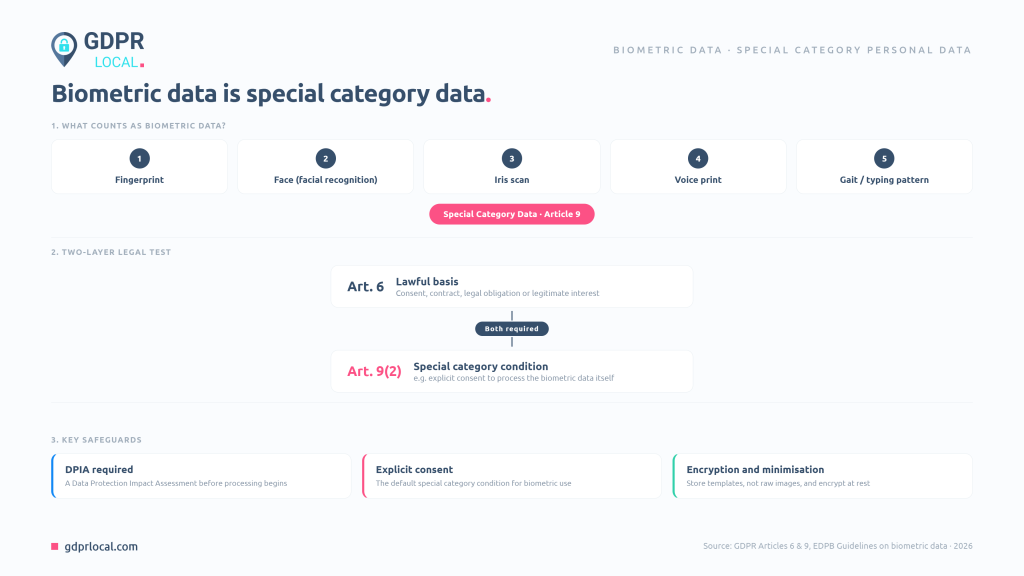
Biometric data includes any attribute that can uniquely identify a person through technical processing, such as facial images, fingerprint data, iris scans, voice recordings, and behavioural patterns such as gait or typing rhythm. If it uniquely identifies a natural person, it qualifies as biometric data under the GDPR.
The permanence of these identifiers is what makes them sensitive. Unlike a password, a fingerprint cannot be reset. That makes a biometric data breach a long-term problem for the affected individuals, which is precisely what the GDPR is designed to address.
How GDPR Classifies Biometric Data?
GDPR classifies biometric data as a special category under Article 9 when it is processed for the purpose of uniquely identifying a natural person. This triggers stricter legal requirements that go beyond standard personal data obligations. Organisations must satisfy two separate legal tests, not one.
Organisations must meet a lawful basis under Article 6 and a specific condition under Article 9(2). Missing either layer is a GDPR violation, regardless of intent.
What Is the Legal Basis for Processing Biometric Data Under GDPR?
Before processing biometric data, organisations must satisfy two requirements: a lawful basis under Article 6 and a specific condition under Article 9(2). Explicit consent from the individual is the most common route, but it is not the only one, and each ground carries its own conditions.
As of March 2025, the European Data Protection Board (EDPB) has consistently confirmed that consent to the processing of biometric data must be freely given, specific, informed, and unambiguous. A pre-ticked box does not qualify.
Obtaining Explicit Consent
Explicit consent is required when no other Article 9(2) condition applies. It must involve a clear, affirmative action from the individual. Verbal agreement or implied consent does not meet the GDPR standard, and full information about intended use must be provided before consent is given.
Real-time biometric identification systems, particularly AI-powered ones, face an even higher threshold. The ICO guidance on biometric data requires that transparency is proportionate to the sensitivity of the processing.
Other Legal Grounds
Beyond consent, GDPR permits biometric data processing for substantial public interest, to protect vital interests in emergencies, or under employment law obligations. None of these is a blanket exemption. Each comes with specific conditions that must be documented.
Public health authorities may process biometric data without consent when managing serious cross-border health threats. Employers may use biometric access controls if employment law or collective agreements in their jurisdiction allow it. Selecting the wrong legal basis, even with good intentions, is a violation.
How Can Organisations Ensure GDPR Compliance for Biometric Data?
Ensuring compliance with the GDPR is crucial for any organisation that processes biometric data. GDPR compliance aims to ensure privacy and protection for sensitive biometric data. All entities GDPR. This involves establishing robust privacy policies, secure storage, and processing practices.
Appointing a Data Protection Officer ensures there’s a named individual accountable for these obligations and a designated contact for data subjects and regulators.
Non-compliance with GDPR can result in severe penalties, hefty fines, reputational damage, and loss of customer trust. Organisations must inform data subjects how their biometric data will be used, maintain a record of processing activities, and implement technological measures to facilitate secure data handling. Regular audits are essential to ensure ongoing compliance and minimise the risk of penalties.
When Is a Data Protection Impact Assessment (DPIA) Required?
A DPIA is mandatory for any high-risk biometric data processing, including large-scale processing, systematic use of biometric recognition systems, and any processing likely to result in discrimination or significant harm to individuals.
DPIAs are not a formality. They require organisations to assess whether processing is necessary and proportionate, two tests that frequently reveal processing activities which should be narrowed or stopped entirely. The ICO publishes DPIA screening guidance specifically relevant to biometric data.
What Security Safeguards Does GDPR Require for Biometric Data?
GDPR requires appropriate technical and organisational measures to protect biometric data. In practice, that means encryption, strict access controls, anonymisation where possible, and regular security audits, alongside staff training to reduce human error.
Data minimisation is equally binding: collect only what is necessary for the stated purpose. According to the NIST Biometric Evaluation Program, well-implemented template protection schemes can significantly reduce re-identification risk while maintaining system accuracy. Storing raw biometric data when a derived template serves the same purpose is noncompliant.

What Rights Do Individuals Have Over Their Biometric Data Under GDPR?
GDPR grants individuals six rights over their biometric data: the right to be informed, the right of access, the right to rectification, the right to erasure, the right to restriction of processing, and the right to data portability. Organisations must have clear, tested processes for handling each type of request.
These are active rights, not theoretical ones. Over 137,000 data subject access requests were filed with EU supervisory authorities in 2023, according to the EDPB Annual Report. Failing to respond within the required timeframe is itself a breach.
How Can Individuals Access or Correct Their Biometric Data?
Individuals can request confirmation of whether an organisation holds their biometric data and receive a copy, free of charge, within one month. They can also request correction of any inaccurate or incomplete information held about them.
If the volume or complexity of requests justifies it, a one-month extension is permitted. Individuals must be told promptly that the extension applies, not after the deadline has passed.
Can Individuals Request Deletion of Their Biometric Data?
Yes. The Right to Erasure applies when biometric data is no longer necessary for its original purpose, when consent is withdrawn, or when processing is found to be unlawful. Organisations must delete the data or restrict its use upon receipt of a valid request.
Restriction is a middle-ground option: data is retained but not actively used, typically while a dispute about accuracy or lawfulness is being resolved.
How Should Organisations Handle a Biometric Data Breach Under GDPR?
GDPR requires organisations to notify the relevant supervisory authority within 72 hours of identifying a biometric data breach. If the breach is likely to pose a high risk to individuals, direct notification to those affected is also required.
Biometric breaches carry the potential for long-term harm that standard data breaches do not. A compromised password can be replaced. Compromised fingerprint data cannot. That distinction is why GDPR treats biometric data breaches with particular severity, and why regulators consistently apply higher scrutiny to organisations that failed to implement preventive controls.
What Are GDPR’s Breach Notification Requirements for Biometric Data?
Supervisory authorities must be notified within 72 hours of the breach being identified. The notification must include the nature of the breach, the categories and approximate number of individuals affected, and the steps taken to address it. Missing this window triggers additional penalties on top of those for the breach itself.
Speed and documentation are both required. Organisations with a tested incident response plan consistently fare better in regulatory investigations than those improvising their response after the fact. GDPRLocal’s Compliance Hub can provide breach management support and help you build and test that plan before a regulator asks to see it.
How Can Organisations Reduce the Impact of a Biometric Data Breach?
Proactive monitoring, regular penetration testing, and clear incident response procedures reduce both the probability and severity of a breach. Limiting data retention periods also reduces exposure: data that is not held cannot be breached.
Identity theft and unauthorised access to secured facilities are among the direct consequences of biometric breaches. Limiting what is stored and for how long is one of the most practical risk-reduction steps available to any organisation operating under the GDPR.
How Is Biometric Data Regulation Evolving?
Biometric regulation is expanding beyond GDPR. The EU AI Act, Illinois’ Biometric Information Privacy Act (BIPA), and California’s CCPA all impose additional or overlapping requirements on organisations using biometric data, particularly in AI-powered systems. As of 2026, staying compliant means tracking multiple frameworks simultaneously.
How Does the EU AI Act Change Obligations Around Biometric Data?
AI systems processing biometric data face a dual compliance burden: GDPR’s requirements for special category data and the EU AI Act’s rules for high-risk AI systems. Real-time remote biometric identification in public spaces is outright prohibited for most use cases under the AI Act.
GDPRLocal’s AI Compliance service can help organisations deal with this compliance challenge – from DPIA support to documentation for high-risk biometric AI systems.
AI systems improve by training on large datasets of biometric information, which raises specific GDPR questions around data minimisation, purpose limitation, and the right to erasure when data has been used in model training.
What New Privacy Laws Are Shaping Biometric Data Regulation?
Illinois’ BIPA and California’s CCPA represent the most significant biometric-specific privacy frameworks outside the EU. Both impose consent requirements, retention limits, and data subject rights that partially mirror GDPR, but with different enforcement mechanisms and penalty structures.
Privacy-enhancing technologies, including Renewable Biometric References (RBRs), are being adopted to reduce the re-identification risk in stored biometric templates. Keeping pace with these developments is now part of GDPR compliance.
Frequently Asked Questions
What is biometric data under GDPR?
Biometric data under the GDPR is any information derived from the technical processing of an individual’s unique physical, physiological, or behavioural characteristics, such as facial images, fingerprints, or voiceprints, that allows that individual to be uniquely identified. Under Article 9, it is a special category of data subject to strict processing conditions.
Why is biometric data a special category under GDPR?
Biometric data is classified as a special category because it uniquely identifies individuals and cannot be changed if compromised. This permanence requires stricter legal safeguards than standard personal data, including an explicit legal basis and heightened security obligations.
What are the legal grounds for processing biometric data under GDPR?
GDPR permits biometric data processing when explicit consent is obtained, when processing is necessary for substantial public interest, to protect vital interests, or to meet employment law obligations. Each ground has specific conditions. Selecting the wrong one is itself a violation.
What rights do individuals have over their biometric data?
GDPR grants individuals the right to access their biometric data, correct inaccuracies, request deletion, restrict processing, and receive a portable copy. Organisations must respond within 30 days and must have documented processes in place to handle each type of request.
How should organisations handle a biometric data breach?
Organisations must notify the relevant supervisory authority within 72 hours of identifying a breach involving biometric data. If the breach creates a high risk for individuals, direct notification to those affected is also required. A tested incident response plan is what regulators expect to see.
Note: This article was created with AI assistance.

About the Author
Ana Mishova
Sales and Business Development Consultant — GDPRLocal
Ana focuses on helping organisations understand their compliance obligations and find the right data protection solutions. At GDPRLocal she works closely with businesses of all sizes, making GDPR and privacy compliance clear, practical, and accessible.