Comparing DPIA Requirements Across Global Jurisdictions
Updated: July 2026
A Data Protection Impact Assessment (DPIA) is the tool regulators expect organisations to use to identify privacy risks before they turn into breaches, regulatory fines, or lasting damage to customer trust.
It’s worth noting that “conduct a DPIA” means something different depending on where your organisation operates. The EU treats it as a detailed, rights-focused legal exercise. Asia-Pacific jurisdictions apply it selectively. US states are still building out their own versions state by state. This guide compares what each region actually requires.
Key Takeaways
• DPIAs are mandatory under GDPR for high-risk processing, and a growing number of Asia-Pacific and US state laws now impose similar, though not identical, obligations.
• Requirements vary significantly by jurisdiction. The EU mandates detailed, rights-focused assessments; Asia-Pacific and the Americas take narrower or newer approaches that still demand a multi-jurisdictional compliance strategy from any organisation operating across borders.
• A compliant DPIA follows a structured process: describing the processing, assessing necessity and risk, documenting mitigation measures, and reviewing the assessment as processing changes, backed by staff training and the right tools.
What Is a Data Protection Impact Assessment?
A Data Protection Impact Assessment is a systematic evaluation used to identify, assess, and reduce privacy risks in a specific data processing activity. A DPIA isn’t just a compliance form to file away. Done properly, it’s a risk management exercise that protects both the individuals whose data is being processed and the organisation running the assessment, and it needs revisiting as that processing changes over time.
What Should an Effective DPIA Include?
A properly built DPIA covers a specific set of elements:
• A clear description of the processing operation and its purpose
• A necessity and proportionality analysis
• A risk evaluation focused on impact to individuals’ rights
• Documented mitigation measures for each risk identified
• Records of any stakeholder consultation carried out
When Is a DPIA Required?
Regulators require a DPIA for specific high-risk processing scenarios. Under GDPR Article 35(3), the main triggers are:
1. Systematic and extensive profiling: automated processing that produces decisions with a significant effect on individuals.
2. Large-scale processing of sensitive data: special category data or criminal conviction data processed at scale.
3. Public monitoring: large-scale, systematic monitoring of publicly accessible areas.
Even outside these triggers, running a DPIA for any substantial new processing activity is worth doing anyway. It catches risks early, when they’re still cheap to fix.
Non-compliance carries real financial exposure: the UK ICO can fine organisations up to £8.7 million or 2% of global annual turnover, whichever is higher, for DPIA failures specifically. Beyond the fine, a documented DPIA process is also one of the clearest ways to show customers and regulators that data protection is taken seriously.
How Do DPIA Requirements Differ Around the World?
DPIA requirements vary substantially by region, which is what makes a single global compliance approach hard to sustain for multinational organisations.
What Does the EU Require Under GDPR?
Article 35 GDPR sets the benchmark: a detailed assessment for any high-risk processing that affects individuals’ rights and freedoms. Compliance requires documentation covering:
• A detailed description of the processing operation
• A necessity and proportionality evaluation
• A full risk assessment
• Records of stakeholder consultation
What Do Asia-Pacific Jurisdictions Require?
DPIA requirements across Asia-Pacific are far less uniform than in the EU. Four jurisdictions currently treat DPIAs as mandatory in specific circumstances: Singapore, South Korea, China, and the Philippines. Singapore’s PDPC guidance sets out when a DPIA is expected, and China’s PIPL imposes strict requirements specifically for sensitive data processing and cross-border transfers.
Vietnam has also moved toward a mandatory model, requiring organisations to submit a DPIA dossier to the Ministry of Public Security under its 2023 data protection decree. Most other jurisdictions in the region take a more flexible approach, treating a DPIA as good practice rather than a hard legal requirement.
What Do the Americas Require?
The US federal government’s DPIA obligations, set out under the eGovernment Act of 2002, apply mainly to the public sector. Private-sector obligations are being built state by state instead: more than 15 states now have comprehensive privacy laws that include some form of data protection assessment requirement, including California, Colorado, Connecticut, Virginia, and Texas among others.
California requires annual cybersecurity risk assessments for high-risk processing under its updated CCPA regulations. Colorado goes further, prohibiting certain high-risk processing activities outright unless a documented impact assessment is in place first. The state-by-state list keeps growing each year, so an assessment obligation that doesn’t apply to your organisation today may apply within a year or two.
How Do You Assess Privacy Risk in a DPIA?
Assessing privacy risk means identifying what could go wrong, judging how likely and how severe it would be, and documenting what you’re doing about it.
What Privacy Risks Should a DPIA Identify?
A DPIA should screen for a specific set of risk categories:
• Identity theft and fraud
• Financial harm
• Reputational damage
• Physical safety risks
• Confidentiality breaches
• Discriminatory outcomes
• Loss of control over personal data
How Do You Evaluate How Severe a Risk Is?
Severity assessment combines two factors: how likely the risk is to materialise, and how serious its impact would be. Key inputs include how sensitive the data is, how many people are affected, and how significant the impact on their rights would be.
Risks that typically rank as high severity include those that stop someone exercising their privacy rights, create social disadvantage, compromise pseudonymisation, or carry a real economic impact on the individual.
How Do You Mitigate Identified Risks?
Effective mitigation works in layers rather than relying on one control. Data minimisation and strict retention limits are the first layer. Technical security measures and staff training form the second. Governance over data-sharing arrangements and clearer privacy notices form the third.
Keep a risk register that tracks each identified threat alongside the measure put in place to address it, and revisit it as processing changes rather than treating it as a one-off document.
Eliminating risk entirely usually isn’t realistic. The practical goal is reducing it to an acceptable level while keeping the processing activity workable, which is a balance rather than a single fixed target.
How Do You Build and Run a DPIA Programme?
A working DPIA programme needs a repeatable process. A one-off document produced under deadline pressure won’t hold up as processing changes over time.
What Are the Steps in the DPIA Process?
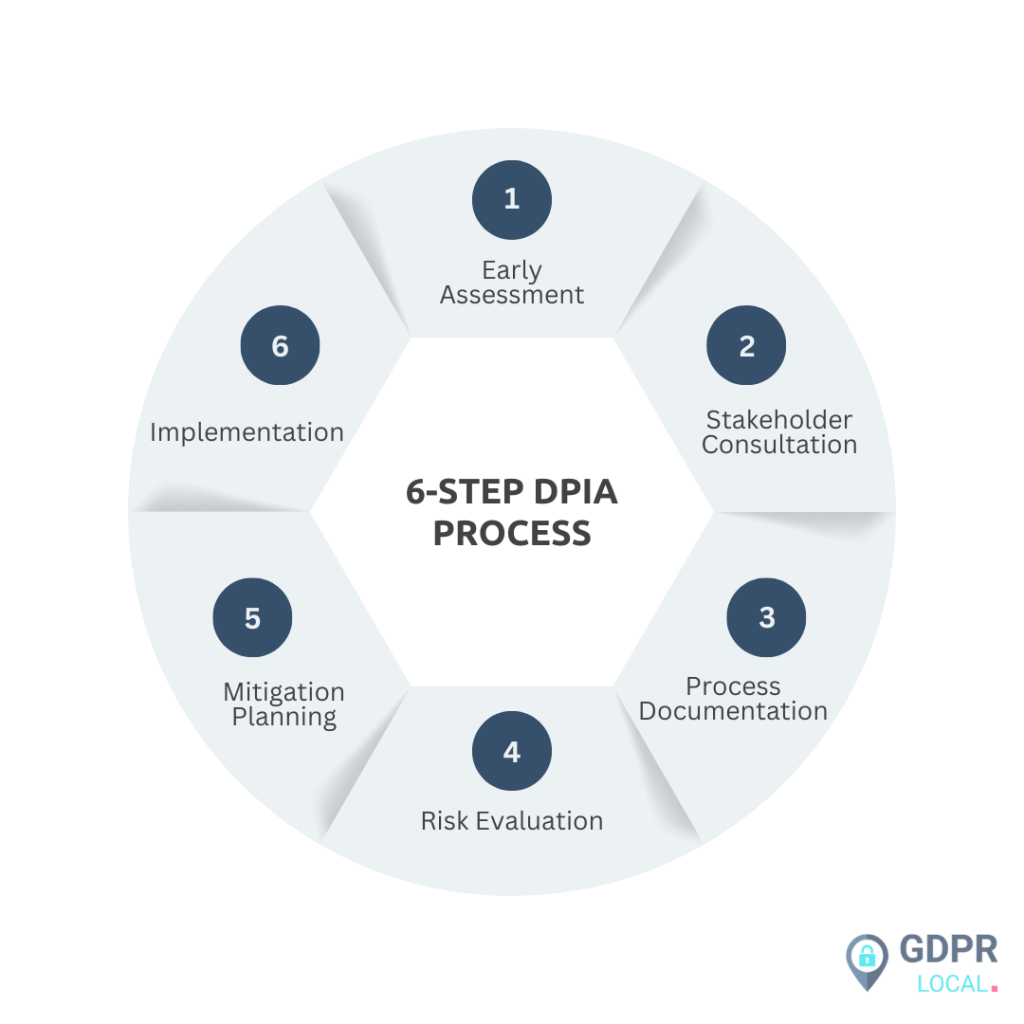
A DPIA generally follows six steps:
1. Identify the need for a DPIA. Screen the proposed processing against the statutory triggers and your organisation’s own risk criteria.
2. Describe the processing. Map the data flows: what’s collected, from whom, why, how long it’s kept, and who it’s shared with.
3. Consider consultation. Involve your DPO where one exists, and consult data subjects or their representatives where that’s proportionate to the processing.
4. Assess necessity and proportionality. Check the lawful basis, purpose limitation, data minimisation, transparency, and how individual rights are supported.
5. Identify and assess risks. Evaluate the likelihood and severity of the risks the processing creates for individuals.
6. Identify measures to address the risks. Document the mitigations and record whether each risk is accepted, reduced, or eliminated.
What Documentation Does a DPIA Require?
A DPIA record should include:
• A detailed description of the processing operation
• The necessity and proportionality analysis
• The risk evaluation and mitigation measures
• Records of stakeholder consultation
• Recommendations from the Data Protection Officer
• A timeline for implementing any agreed measures
Using a standard template keeps this consistent across the organisation, though it’s worth adapting the template to your own processing activities rather than using it unchanged.
How Often Should a DPIA Be Reviewed?
A DPIA isn’t a document you file once and forget. It needs a review cycle covering:
• Routine reviews: scheduled checks that the assessment still reflects how the processing actually works.
• Change triggers: a new review whenever the technology, purpose, or risk profile changes materially.
• Documentation updates: a running record of what changed, when, and why.
Your Data Protection Officer should stay involved throughout this cycle, from the first draft through every later review.
What Are Some Best Practices for DPIA Compliance?
How Should You Build DPIA Templates?
A good template is standardised enough to apply consistently across different processing activities, while still covering the specifics: the operational details, the risk evaluation, and the mitigation strategy for each activity it’s used on.
What Technology Can Support DPIA Work?
Tools can meaningfully speed up DPIA work. CNIL’s open-source PIA software is a widely used example, offering a visual way to work through risk and an open-source codebase organisations can adapt to their own systems. Useful capabilities to look for include automated assessment distribution, centralised documentation, and easier collaboration between the teams who need to contribute to a DPIA.
What Staff Training Does DPIA Compliance Need?
Training needs to cover both the general DPIA process and the specific rules that apply in each jurisdiction and sector your organisation operates in. Keep records of who’s completed training and check understanding periodically rather than assuming a single session covers it permanently.
Anyone acting as a Data Protection Officer needs training that goes beyond this baseline, since they’re the ones expected to give authoritative guidance when a DPIA raises a genuinely difficult question.
Conclusion
DPIAs are a legal requirement in some jurisdictions and good practice everywhere else, but what counts as “doing it properly” still depends heavily on where your organisation operates. The EU’s Article 35 process is the most detailed and rights-focused; Asia-Pacific applies mandatory DPIAs in four jurisdictions with room for more to follow; US states are adding assessment requirements year on year. Building one adaptable DPIA process, then tailoring the depth and documentation to whichever jurisdiction applies, is more sustainable than starting from scratch each time a new law lands.
Need help running a DPIA across multiple jurisdictions? Our team can help. Contact us at info@gdprlocal.com.
Frequently Asked Questions
When is a Data Protection Impact Assessment required?
A DPIA is required for high-risk data processing activities, such as large-scale profiling, processing of sensitive data, or public monitoring. Organisations are also encouraged to run DPIAs for any substantial processing activity to catch risks early, even where it isn’t strictly required.
Do DPIA requirements differ by country?
Yes. GDPR mandates detailed DPIAs across the EU. Asia-Pacific countries such as China and Singapore have mandatory requirements in specific circumstances, while others in the region treat DPIAs as best practice. In the US, assessment requirements are being built state by state, with California and Colorado among the states applying them to high-risk processing.
What should be included in a DPIA?
A DPIA should document the purpose of the processing, assess its necessity and proportionality, identify risks to individuals, set out mitigation measures, and record any stakeholder consultation and review activity carried out.
Disclaimer: This blog post is intended solely for informational purposes. It does not offer legal advice or opinions. This article is not a guide for resolving legal issues or managing litigation on your own. It should not be considered a replacement for professional legal counsel and does not provide legal advice for any specific situation or employer.

About the Author
Zlatko Delev
Country Manager & Head of Commercial — GDPRLocal
Zlatko specialises in data protection compliance, ISMS strategy, and AI law. With a legal background and hands-on experience supporting organisations globally, he helps businesses navigate GDPR, the EU AI Act, and international privacy frameworks.

About the Author
Head of Commercial & Country Manager
Zlatko Delev is Head of Commercial and Country Manager at GDPRLocal, where he leads the company’s commercial strategy and market presence. He brings international experience across sales, marketing, and customer success, along with a legal background from his studies at Iustinianus Primus Law School in Skopje, Macedonia.
Zlatko sits at the front line of GDPRLocal’s client relationships, guiding organisations through the first stages of their compliance journey and helping them understand where they stand and where they need to go on GDPR, information security, and the emerging landscape of AI regulation. His role bridges commercial strategy with practical data protection knowledge, ensuring clients get clear, actionable direction from their very first conversation with GDPRLocal.
Alongside his commercial focus, Zlatko has trained extensively in project management and organisational leadership, including risk management, stakeholder communication, agile methodology, and digital marketing, a broad skill set that supports his structured, delivery-focused approach to growing GDPRLocal’s business internationally.