The ROI of Data Protection When Most Of The Budget Goes to AI
Data protection rarely produces revenue, so its return shows up as losses avoided and faster sales. That return is growing as AI spreads personal data into more tools. IBM’s 2026 Cost of a Data Breach Report puts the global average cost of a breach at $4.99 million.
Key Takeaways
• Data protection has a return, measured as expected loss avoided plus deals it helps close. The formula below lets a finance team quantify both.
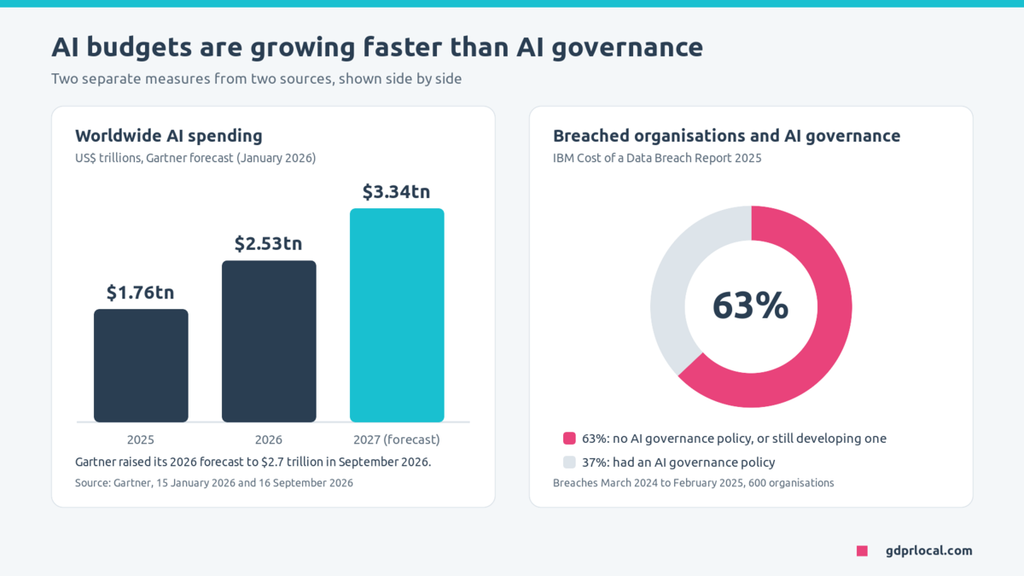
• AI budgets are growing fast while AI governance lags. In IBM’s 2025 report, 63% of breached organisations had no AI governance policy or were still developing one.
• The fix is to keep investing in AI and fund the controls that let it ship: an AI inventory, access controls, vendor DPAs, DPIAs, training and a named owner.
Why Does Data Protection Always Lose the Budget Fight?
When I talk to clients about their budgets, the conversation usually ends up at the same question: what does this return? Every line in the plan is judged on that basis. Data protection tends to come last because the honest answer is that it doesn’t produce revenue you can point to.
That view is partly fair. A privacy programme does not sell a product or open a market. When it works, nothing happens: no breach, no complaint, no regulator letter. Nobody writes a board report about the incident that never occurred.
The problem is the measurement. A spend judged only on visible revenue will always lose to one that promises growth.
Where Is the Money Going Instead?
Into AI. Gartner forecast in September 2026 that worldwide AI spending will reach $2.7 trillion in 2026, a 49.5% increase on the year before. Its January 2026 forecast had put the 2026 figure at $2.52 trillion, so the estimate rose during the year.
Privacy teams see the same shift. In Cisco’s 2025 Data Privacy Benchmark Study, a survey of 2,600 privacy and security professionals in 12 countries, 99% of respondents said they expected to reallocate resources from privacy budgets to AI initiatives in the future.
For a growing company, this rarely happens as a single decision. A team adds an AI tool. Another team adds a second one. The compliance work that should come with each tool slips to next quarter.
How Has AI Changed the Risk?
AI puts more personal data into more systems, often faster than anyone checks. IBM’s research shows where it leaks.
In IBM’s 2025 Cost of a Data Breach Report (breaches at 600 organisations, March 2024 to February 2025):
• 13% of organisations reported breaches of AI models or applications, and 8% did not know whether they had been compromised in this way.
• Of those breached, 97% reported not having AI access controls in place.
• 63% of breached organisations had no AI governance policy or were still developing one.
• One in five organisations reported a breach due to shadow AI, meaning AI use that nobody approved. Those with high levels of shadow AI saw breach costs $670,000 higher on average than those with low levels or none.
The 2026 report (602 organisations, March 2025 to February 2026) found that more than 20% of organisations reported a breach targeting AI models or applications. The most common causes were AI-related weaknesses: compromised APIs, applications or plug-ins, and cloud misconfigurations affecting AI workloads.
Staff behaviour adds to this. Cisco’s 2025 study found that 64% of respondents worried about accidentally sharing sensitive information, and nearly half admitted entering personal employee data or non-public data into generative AI tools.
What Does a Data Breach Actually Cost Now?
IBM’s 2026 report puts the global average cost of a breach at $4.99 million. Breaches in which attackers used AI cost an average of $6 million. In the 2025 report, the US average reached a record $10.22 million, and the average breach took 241 days to identify and contain.
These averages come from IBM’s study population, which includes large organisations. They do not translate directly to a 50-person company. They show the direction of travel and the cost categories to plan for.
The average also leaves out costs that a growing company feels directly:
• Regulator action. According to DLA Piper’s January 2026 survey, European supervisory authorities issued around €1.2 billion in GDPR fines in 2025, and breach notifications rose 22% to an average of 443 a day. Our list of the biggest GDPR fines shows the cases behind the totals.
• Lost or stalled deals. An enterprise buyer that sees a breach in your history, or no answers in your security questionnaire, can pause or end a deal.
• Contract penalties. Customer contracts and DPAs often include notification duties, audit rights and indemnities that come into play after an incident.
• Management time. Senior people spend weeks investigating, dealing with customers, insurers, and regulators. IBM’s 2025 report found that most organisations that recovered took more than 100 days.
AI Investment vs Data Protection Investment: Side by Side
| AI investment | Data protection investment | |
|---|---|---|
| What you spend | Licences, build time, data work, change management | Policies, inventory, access controls, assessments, training, contracts |
| What it returns | Productivity, new features, lower cost per task | Loss avoided, faster enterprise sales, readiness for regulator questions |
| How the return shows up | Visible: time saved, output, revenue | Mostly invisible: incidents that do not happen, questionnaires answered in days |
| What happens if it fails | A project underdelivers and is cut or reworked | A breach, a complaint, a regulator letter or a lost customer |
| Who notices first | The team using the tool | A customer, an attacker or a regulator |
| When you see the cost | During the project | Months later, often at the worst time |
How Do You Calculate the ROI of Data Protection?
Two lines are enough.
Expected annual loss = likelihood of an incident in a year × cost of the incident
ROI = (loss avoided + deals unlocked − cost of the programme) ÷ cost of the programme
Loss avoided is the expected annual loss without the programme minus the expected annual loss with it. Deals unlocked is the gross margin from deals that needed answers on data protection to close.
Worked Example (Illustrative Numbers Only)
The figures below assume a hypothetical 50-person SaaS company. They are not benchmarks. Replace each one with your own estimate.
• Assumed cost of a significant incident: $250,000
• Assumed likelihood per year without a programme: 10%. Expected annual loss: $25,000
• Assumed likelihood per year with a programme: 5%. Expected annual loss: $12,500
• Loss avoided: $25,000 − $12,500 = $12,500
• Assumed gross margin from deals that required a completed security questionnaire and DPA: $30,000
• Assumed annual cost of the programme: $20,000
ROI = ($12,500 + $30,000 − $20,000) ÷ $20,000 = 1.125, or about 113%
On loss avoided alone, the same programme returns ($12,500 − $20,000) ÷ $20,000 = −37.5%. That is the honest version of the client’s objection. The return becomes positive once you count the sales side, which is why it belongs in the calculation.
Cisco’s 2025 study points the same way. 96% of organisations reported that the returns from privacy investment significantly outweigh the investment.
What Does Data Protection Give Back Besides Avoided Fines?
Shorter sales cycles. Many enterprise buyers send security and privacy questionnaires before they sign. A company with an up-to-date record of processing, signed vendor DPAs and clear answers on AI use can complete them faster.
Customer trust. In Cisco’s 2025 study, 86% of respondents said privacy laws positively impacted their organisations. The Cisco 2026 study found that 46% of respondents identify clear communication about data use as the most effective action to build customer confidence.
AI governance readiness. The EU AI Act’s AI literacy duty in Article 4 has applied since 2 February 2025 and covers deployers of AI systems as well as providers. Article 99 sets maximum fines of up to €35 million or 7% of worldwide annual turnover for prohibited practices, and up to €15 million or 3% for breaches of other listed obligations. For SMEs, the lower of the two amounts applies. A company with an AI inventory and a named owner has the basic answers ready when a customer or regulator asks.
Cleaner data for AI. The work that data protection requires (knowing what data you hold, why, where it goes and how long you keep it) is the same work that makes data usable for AI projects.
What’s the Minimum a Company Using AI Should Have in Place?
• An AI use policy that lists approved tools, what data may go into them, and when a person must check the output.
• An inventory of AI tools, including AI features inside software you already pay for.
• Access controls on AI tools and the data they can reach, so that a compromised account or plug-in exposes as little as possible.
• DPIAs for AI uses that involve personal data and are likely to result in a high risk to people. Our guide to the data protection impact assessment explains when one is required.
• Signed DPAs with AI vendors that process personal data on your behalf, including clear terms on whether the vendor may use your data for its own purposes.
• AI literacy training matched to each role. GDPRLocal runs AI and data protection training.
• A breach response plan that covers AI tools and vendors, with a clear route for staff to report a mistake.
• A named owner for AI governance who can approve, refuse and review.
Frequently Asked Questions
Is GDPR Compliance Worth the Cost for a Small Company?
Usually, once you count both deals and losses avoided. Use the formula above with your own numbers. For many small companies, passing enterprise procurement is the larger part of the return.
What Is Shadow AI?
Shadow AI is the use of AI tools that the company has not approved or does not know about. IBM’s 2025 report found that one in five organisations reported a breach due to shadow AI.
How Much Does a Data Breach Cost a Small Business?
The IBM averages describe its study population and should not be applied directly to a small company. A better estimate comes from your own numbers: response and legal costs, customer notification, lost contracts and staff time.
Does the EU AI Act Apply If We Only Use AI Tools?
It can. Companies that use AI systems professionally are deployers under the AI Act, and the AI literacy duty in Article 4 applies to deployers. Other duties depend on how the tool is used, for example, where it is high-risk or falls under the transparency rules.
Who Should Own AI Governance?
One senior person with authority to approve and refuse AI tools, supported by data protection, security and IT. Our data protection officer service and GDPR consultants can support that owner.
Conclusion
Keep investing in AI and measure data protection the way you measure everything else, including the loss it prevents and the deals it unlocks. Once those numbers are on the table, the budget discussion includes what the company stands to lose without it, and data protection stops coming last by default.
GDPRLocal helps companies implement AI governance and data protection through AIGo, our AI governance service. You can also start with a free account on the GDPRLocal Compliance Hub.
Disclaimer: This blog post is for informational purposes only. It does not offer legal advice or opinions. This article is not a guide for resolving legal issues or managing litigation on your own. It should not be considered a replacement for professional legal counsel and does not provide legal advice for any specific situation or employer.

About the Author
Head of Commercial & Country Manager
Zlatko Delev is Head of Commercial and Country Manager at GDPRLocal, where he leads the company’s commercial strategy and market presence. He brings international experience across sales, marketing, and customer success, along with a legal background from his studies at Iustinianus Primus Law School in Skopje, Macedonia.
Zlatko sits at the front line of GDPRLocal’s client relationships, guiding organisations through the first stages of their compliance journey and helping them understand where they stand and where they need to go on GDPR, information security, and the emerging landscape of AI regulation. His role bridges commercial strategy with practical data protection knowledge, ensuring clients get clear, actionable direction from their very first conversation with GDPRLocal.
Alongside his commercial focus, Zlatko has trained extensively in project management and organisational leadership, including risk management, stakeholder communication, agile methodology, and digital marketing, a broad skill set that supports his structured, delivery-focused approach to growing GDPRLocal’s business internationally.