How Long Should Personal Data Be Kept For
Organisations across the UK face an important question: how long should they retain personal data under the GDPR? The answer isn’t in a simple table of dates; it requires an understanding of legal obligations, business needs, and individual privacy rights.
The storage limitation principle represents one of GDPR’s most fundamental requirements. ICO enforcement actions demonstrate that indefinite data retention can result in fines of up to £17.5 million or 4% of global annual turnover.
Key Takeaways
• Organisations must retain personal data only as long as necessary for the specific purposes for which it was collected, ensuring compliance with the GDPR’s storage limitation principle.
• Developing and maintaining a clear, documented data retention policy with regular reviews and secure deletion processes is essential to balancing legal obligations, business needs, and individual privacy rights.
• Extended retention of personal data is permitted only under specific circumstances, such as public interest archiving, scientific or historical research, or statistical purposes. It must be accompanied by appropriate technical and organisational measures to protect data subjects.
What is the GDPR storage limitation principle?
The storage limitation principle, established under GDPR Article 5(1)(e), requires that personal data must be kept in a form which permits identification of data subjects for no longer than necessary for the purposes for which the personal data are processed. This fundamental rule means organisations cannot simply retain personal data indefinitely without a clear justification.
Unlike prescriptive regulations that specify exact timeframes, GDPR places the responsibility on organisations to determine appropriate retention periods based on their specific processing purposes. The regulation deliberately avoids setting standard retention periods because data needs vary significantly across industries and business models.
What are the key aspects of the storage limitation principle?
• Purpose-driven retention: Data can only be retained as long as it serves the original processing purpose
• Prohibition of indefinite storage: Keeping data “just in case” violates compliance requirements
• Regular review obligations: Organisations must actively assess whether continued retention remains justified
• Documentation requirements: Retention decisions must be recorded and defensible
The principle works in conjunction with data minimisation, ensuring organisations collect only necessary data and retain it only as long as required. This approach reflects GDPR’s privacy-by-design philosophy, in which data protection considerations must be embedded in business processes from the outset.
Processing personal data beyond justified retention periods transforms lawful processing into potential compliance violations. Regulators consistently emphasise that organisations must demonstrate an ongoing necessity for data retention, not simply assume it remains appropriate.
What are the legal requirements and compliance risks for data retention?
The UK GDPR, reinforced by the Data Protection Act 2018, maintains the exact storage limitation requirements as the EU regulation. Organisations operating in the UK must ensure their retention practices align with these legal frameworks, regardless of their size or sector.
The ICO has consistently demonstrated its willingness to pursue enforcement action against organisations with poor retention practices. Recent cases highlight how inadequate data retention policies can result in significant financial penalties and reputational damage. Non-compliance with storage limitations can trigger investigations that examine an organisation’s entire data protection framework.
How does storage limitation connect to data minimisation?
Storage limitation and data minimisation work as complementary principles. While data minimisation focuses on collecting only necessary information, storage limitation governs how long that information remains within organisational systems. Together, they ensure organisations maintain lean, purpose-driven data holdings.
Which legal obligations require extended data retention?
Specific regulatory requirements mandate more extended retention periods that organisations must balance against GDPR obligations:
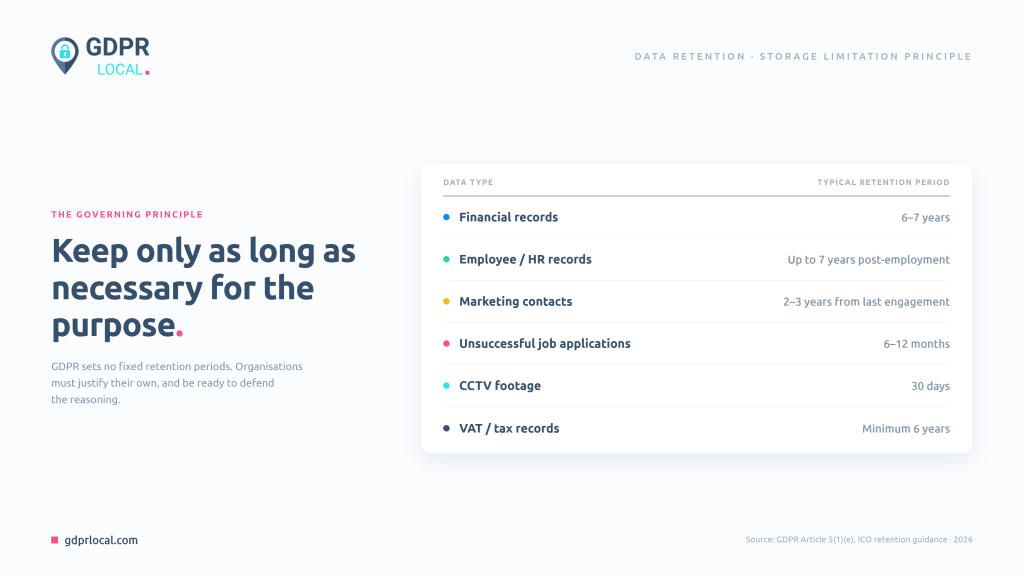
| Record Type | Typical Retention Period | Legal Basis |
| Financial transactions | 6-7 years | Tax and anti-money laundering laws |
| Employee records | Up to 7 years post-employment | Employment law and potential claims |
| Health records | Varies by sector | Professional and regulatory requirements |
| VAT records | Minimum 6 years | HM Revenue & Customs requirements |
Organisations must carefully read through the requirements, ensuring they retain personal data held for legitimate regulatory purposes while avoiding excessive retention in other areas.
The ICO’s guidance emphasises that even where legal obligations require extended retention, organisations should regularly review whether the personal data elements remain necessary for those specific purposes. Anonymisation or pseudonymisation may allow organisations to satisfy regulatory requirements while reducing privacy risks.
How do you build a GDPR-compliant data retention policy?
A good data retention policy forms the cornerstone of GDPR compliance, providing clear guidance for how your organisation handles personal data throughout its lifecycle. Effective policies must be documented, regularly reviewed, and integrated into daily business operations.
What should a data retention policy include?
Your retention policy should identify:
• All categories of personal data your organisation processes
• The specific purposes for which each data type is collected and used
• Justified retention periods for each category
• Processes for regular review and assessment
• Procedures for secure deletion or anonymisation
• Responsibilities for policy implementation and maintenance
How does data mapping support retention compliance?
Before establishing retention periods, organisations must understand what personal data they hold and why. This requires data mapping that captures:
1. Data sources: Where personal data enters your organisation
2. Processing purposes: Why each data category is collected
3. Data flows: How information moves through your systems
4. Storage locations: Where data resides, including backups and archives
5. Access controls: Who can view or modify different data types
How to create effective data retention schedules?
Retention schedules translate policy principles into practical operational guidance. These documents should specify exact timeframes for different data categories, along with the business or legal justification for each period.
Effective retention schedules typically organise data by:
• Business function: HR, finance, marketing, customer service
• Data sensitivity: Basic contact details vs. sensitive personal data
• Processing purpose: Contract performance, legal compliance, legitimate interests
• Regulatory requirements: Sector-specific obligations that mandate extended retention
Organisations should avoid overly complex schedules that become difficult to implement consistently. Clear, actionable guidance enables staff to make appropriate retention decisions without requiring specialised legal knowledge.
How often should retention policies be reviewed?
Data retention policies require ongoing maintenance to remain effective and compliant. Organisations should establish regular review cycles that assess:
• Whether existing retention periods remain appropriate
• Changes in legal or regulatory requirements
• New business processes that generate additional personal data
• Feedback from data subjects and regulators
• Technological developments that enable better data management
How to determine appropriate data retention periods?
Establishing justified retention periods requires balancing multiple competing considerations. Organisations must weigh business needs against privacy rights while ensuring compliance with legal obligations. This balancing act demands careful analysis rather than arbitrary decision-making.
What criteria justify a data retention period?
When determining how long data should be retained, consider these key factors:
Legal and Regulatory Requirements: Many industries face specific retention obligations that establish minimum timeframes. Financial services organisations must retain transaction records for anti-money laundering purposes, while healthcare providers may need to maintain patient records for decades.
Business Operational Needs: Organisations must assess how long they genuinely need personal data for legitimate business purposes. This includes:
• Contract performance and warranty obligations
• Customer relationship management
• Internal reporting and analysis requirements
• Audit purposes and compliance monitoring
Individual Privacy Rights: GDPR requires organisations to consider the impact of extended retention on data subjects. Longer retention periods increase privacy risks and may conflict with individual expectations about how their data is used.
What are industry best practices for data retention periods?
Established sector norms provide helpful guidance, though organisations must still justify their specific choices:
• Marketing communications: 2-3 years from last engagement, unless consent is withdrawn earlier
• Customer service records: 6 years to align with contract limitation periods
• Recruitment records: 6-12 months for unsuccessful applications
• CCTV footage: 30 days unless specific incidents require investigation.
How should risk assessment inform retention decisions?
Retention period decisions should incorporate a risk assessment that evaluates:
• Data sensitivity: Sensitive data typically requires shorter retention periods
• Processing volume: Large datasets may require more stringent controls
• Security measures: Strong protection may support longer retention where justified
• Data subject expectations: Consumer-facing organisations often face higher scrutiny
When and how should organisations delete personal data?
Effective data deletion requires systematic processes that ensure personal data is removed wholly and securely when retention periods expire. Organisations must move beyond ad-hoc deletion to establish regular, documented procedures that demonstrate ongoing compliance.
What review processes ensure timely data deletion?
Organisations should implement scheduled reviews that assess whether continued retention remains justified for different data categories. These reviews typically operate on monthly, quarterly, or annual cycles, depending on the data type and business context.
Effective review processes include:
• Automated alerts: Systems that flag data approaching retention limits
• Systematic assessment: Regular evaluation of whether processing purposes still apply
• Documentation requirements: Records showing review dates and decisions made
• Escalation procedures: Clear paths for resolving complex retention questions
What methods securely delete personal data?
When retention periods expire, organisations must ensure personal data is permanently and securely removed. Different deletion methods suit different situations:
Complete Deletion: Physical destruction of storage media or cryptographic erasure ensures data cannot be recovered. This approach suits situations where there is no legitimate need to retain any information.
Anonymisation: Transforming data so it no longer permits identification of data subjects allows indefinite retention for statistical purposes. Adequate anonymisation requires removing or altering identifying elements while preserving analytical value.
Organisations must ensure anonymisation techniques genuinely prevent re-identification, considering both current technology and potential future developments.
How should retention policies address backups and archives?
Data retention policies must address information stored in backup systems and offline archives. While immediate deletion from backup systems may not always be technically feasible, organisations must ensure:
- Data is not restored to active systems after deletion deadlines
- Backup retention periods align with primary data retention requirements
- Legacy systems receive regular attention to prevent indefinite retention
- Clear procedures exist for handling backup data during restoration activities
How should organisations respond to data erasure requests?
GDPR’s right to erasure under Article 17 allows data subjects to request deletion of their data under specific circumstances. Organisations must establish transparent processes to:
- Receive and acknowledge erasure requests
- Assess whether legal grounds for erasure exist
- Coordinate deletion across all systems and third parties
- Document decisions and actions taken
- Respond to requesters within one month
Erasure requests may conflict with legal retention obligations, requiring careful analysis to determine which requirements take precedence.
What exceptions allow longer data retention under GDPR?
GDPR recognises that certain activities may justify extended or indefinite retention of personal data, provided organisations implement appropriate safeguards. These exceptions require careful application and ongoing justification rather than blanket permission for unlimited retention.
When can personal data be retained for public interest archiving?
Libraries and similar institutions may retain personal data indefinitely when serving legitimate public interest archiving purposes. This exception recognises the societal value of preserving historical records while requiring appropriate technical and organisational measures to protect individual privacy.
Organisations claiming this exception must demonstrate:
• Clear public interest in preserving the specific data
• Appropriate access controls limiting who can view archived information
• Regular assessment of whether the public interest justification continues
• Implementation of privacy-enhancing technologies where feasible
When can personal data be retained for research purposes?
Research activities may justify extended retention where deletion would undermine legitimate scientific or historical research objectives. However, this exception requires robust safeguards, including:
• Purpose limitation: Data can only be used for the specified research purposes
• Technical measures: Pseudonymisation, encryption, or other privacy-enhancing technologies
• Access controls: Limiting researcher access to necessary data elements
• Regular review: Ongoing assessment of research necessity and privacy impact
Organisations must distinguish between genuine research activities and broader business intelligence or marketing analysis, which typically cannot rely on this exception.
When can personal data be retained for statistical purposes?
Personal data processed solely for statistical purposes may be retained indefinitely if appropriate safeguards are in place. This exception supports legitimate statistical analysis while protecting individual privacy through technical measures.
Effective statistical processing typically requires:
• Aggregation or anonymisation techniques that prevent individual identification
• Access controls limiting who can view detailed statistical data
• Clear policies separating statistical use from other business purposes
• Regular assessment of anonymisation effectiveness
What safeguards are required for extended retention exceptions?
All extended retention under GDPR exceptions must include appropriate technical and organisational measures to protect individual rights. These safeguards typically include:
• Pseudonymisation: Replacing identifying information with artificial identifiers
• Encryption: Protecting data confidentiality through cryptographic controls
• Access controls: Limiting data access to authorised personnel only
• Purpose limitation: Ensuring data is only used for the specified exempt purposes
• Regular review: Ongoing assessment of necessity and proportionality
How can technology automate data retention management?
Modern organisations increasingly rely on automated systems to manage data retention at scale. Technology solutions can reduce human error, ensure the consistent application of retention policies, and provide audit trails that demonstrate compliance efforts.
How do customer data platforms help manage data retention?
Customer Data Platforms (CDPs) offer sophisticated capabilities for automated data lifecycle management. These systems can:
• Tag data by category: Automatically classify personal data based on predefined rules
• Apply retention rules: Set automatic expiration dates aligned with policy requirements
• Trigger deletion workflows: Initiate secure deletion processes when retention periods expire
• Generate compliance reports: Provide audit trails showing retention decisions and actions
How do you set up automated data retention systems?
Effective automation requires careful planning and configuration:
1. Data classification: Establish clear categories with appropriate retention periods
2. Rule configuration: Program systems to apply retention policies consistently
3. Exception handling: Define processes for unique cases requiring manual review
4. Monitoring and alerting: Implement oversight to catch system failures or edge cases
5. Regular testing: Verify that automated processes operate as intended
What integrations are needed for automated retention management?
Automated retention systems must integrate with existing technology infrastructure to ensure coverage. Key integration points include:
• Database systems: Ensuring retention rules apply across all data repositories
• Cloud storage: Coordinating retention policies across multiple cloud providers
• Backup systems: Aligning automated deletion with backup retention schedules
• Third-party systems: Extending retention controls to external service providers
Organisations should avoid creating isolated retention systems that miss significant data holdings or create compliance gaps.
How should automated systems monitor retention compliance?
Automated systems should generate regular reports demonstrating compliance activities:
• Deletion logs: Records showing what data was deleted and when
• Retention summaries: Current status of different data categories
• Exception reports: Cases requiring manual intervention or special handling
• Audit trails: Complete history of retention decisions and system activities
These reports support both internal governance and regulatory compliance efforts.
What retention obligations apply when sharing data with third parties?
When personal data is shared with external organisations, retention obligations extend beyond your direct control. Adequate data protection requires coordinating retention policies across the entire data supply chain to ensure the consistent application of deletion requirements.
What must data processing agreements say about retention?
Data Processing Agreements (DPAs) with third parties must specify retention and deletion obligations. These contracts should address:
• Aligned retention periods: Ensuring processors follow controller retention schedules
• Deletion coordination: Procedures for synchronised deletion across organisations
• Audit rights: Controller’s ability to verify processor compliance with retention requirements
• Breach notification: Reporting obligations when retention failures occur
How do organisations manage shared data retention obligations?
Complex data sharing arrangements require sophisticated coordination mechanisms:
• Shared retention schedules: Common frameworks applied across multiple organisations
• Deletion notifications: Systems that alert all parties when data should be removed
• Compliance monitoring: Regular verification that shared retention obligations are met
• Documentation requirements: Records showing how multi-party retention is managed
What contractual elements govern third-party data retention?
Contracts with data processors and partners should explicitly address retention responsibilities:
| Contract Element | Purpose | Key Requirements |
| Retention periods | Specify exact timeframes | Align with controller policies |
| Deletion procedures | Define secure removal methods | Ensure destruction |
| Coordination mechanisms | Enable synchronised deletion | Prevent data persistence |
| Audit provisions | Allow compliance verification | Include retention review rights |
How should organisations manage third-party retention risks?
Organisations must assess and manage retention-related risks from external partners:
• Due diligence: Evaluating third-party retention capabilities during selection
• Ongoing monitoring: Regular assessment of partner compliance with retention obligations
• Contingency planning: Procedures for addressing third-party retention failures
• Contract termination: Ensuring data deletion when relationships end
Poor third-party retention management can expose organisations to regulatory action, even when their direct data-handling practices comply with requirements.
What are some practical steps for implementing a data retention policy?
Implementing effective data retention requires a systematic approach that addresses policy development, operational integration, and ongoing compliance monitoring. Organisations should view retention management as an ongoing business process rather than a one-time compliance exercise.
How do you conduct a data retention audit?
Begin by conducting an audit of your current data holdings:
1. Inventory all personal data: Document what information you collect and store
2. Map data flows: Understand how information moves through your organisation
3. Identify retention periods: Assess current practices against legal requirements
4. Highlight compliance gaps: Note areas requiring immediate attention
5. Prioritise remediation: Focus on the highest-risk areas first
GDPRLocal can run this audit for you, mapping your data holdings, identifying retention gaps, and helping you build a defensible schedule.
What staff training supports data retention compliance?
Effective retention requires organisation-wide understanding and commitment:
• Role-specific training: Tailor education to different job functions and responsibilities
• Regular updates: Ensure staff understand policy changes and new requirements
• Practical guidance: Provide clear instructions for retention decisions
• Escalation procedures: Define when staff should seek specialist advice
How do you establish effective retention review cycles?
Create regular review processes that ensure retention policies remain current and effective:
• Annual policy review: Assessment of retention schedules and procedures
• Quarterly compliance checks: Regular monitoring of retention practice effectiveness
• Monthly deletion cycles: Systematic removal of data reaching retention limits
• Ad-hoc assessments: Additional reviews triggered by business or regulatory changes
How do you measure data retention compliance effectiveness?
Develop metrics that demonstrate retention policy effectiveness:
• Deletion completion rates: Percentage of data successfully removed within required timeframes
• Policy adherence scores: Compliance with established retention procedures
• Staff training completion: Evidence of organisation-wide retention of knowledge
• Audit findings: Results from internal and external retention assessments
What sector-specific data retention obligations must organisations follow?
Data retention obligations extend beyond GDPR to include sector-specific requirements that may mandate longer retention periods. Organisations must carefully balance these competing demands while maintaining compliance.
What sector-specific retention requirements apply?
Different industries face varying retention obligations:
What retention periods apply in financial services?
• Anti-money laundering records: 5-7 years
• Investment advice records: Up to 10 years
• Insurance claims: 6-7 years minimum
What retention periods apply in healthcare?
• Patient records: Varies by jurisdiction and patient age
• Clinical trial data: 15+ years in some cases
• Occupational health records: 40+ years for exposure monitoring
What retention periods apply in education?
• Student academic records: Permanent retention is often required
• Disciplinary records: Varies by institution policy
• Financial aid documentation: Multiple years for audit purposes
What retention periods apply to employee data?
Employee data presents particular challenges due to extended limitation periods for discrimination and other employment claims. Organisations typically retain:
• Personnel files: 6-7 years post-employment
• Payroll records: 6+ years for tax compliance
• Training records: Duration varies by legal requirements
• Health and safety data: Extended periods for occupational exposure
How do organisations balance legal retention obligations with GDPR?
When legal obligations conflict with GDPR storage limitations, organisations should:
1. Identify specific legal requirements: Understand exactly what must be retained and why
2. Minimise data scope: Retain only personal data elements required by law
3. Implement safeguards: Use pseudonymization or access controls to reduce privacy impact
4. Document decisions: Record rationale for extended retention periods
5. Regular review: Assess whether legal obligations continue to apply
If you’re dealing with conflicting retention obligations across sectors or jurisdictions, GDPRLocal’s consultancy team can advise on how to balance legal requirements against GDPR storage limits.
What are the most common data retention mistakes?
Understanding the common causes of retention policy failures helps organisations avoid costly compliance errors. These mistakes often result from inadequate planning, poor implementation, or an inability to adapt to changing circumstances.
Why are indefinite retention policies a compliance risk?
Many organisations default to keeping data “forever” without clear justification. This approach violates GDPR’s storage limitation principle and creates unnecessary privacy risks. Instead:
• Establish clear retention periods for each data category
• Document business or legal justification for extended retention
• Implement regular review cycles to assess the ongoing necessity
• Default to shorter retention periods where multiple options exist
Why must retention policies cover backup systems?
Organisations frequently overlook data stored in backup systems, archives, or legacy platforms. These “forgotten” repositories can contain personal data subject to the exact retention requirements as active systems. Ensure retention policies address:
• Regular backup retention schedules aligned with primary data policies
• Procedures for handling backup data during system restoration
• Legacy system migration or decommissioning plans
• Cloud storage and third-party backup services
Why does inadequate documentation undermine retention compliance?
Poor record-keeping undermines the effectiveness of retention policies and regulatory compliance. Organisations should maintain comprehensive documentation covering:
• Retention policy development and approval processes
• Regular review activities and outcomes
• Deletion activities and completion verification
• Staff training and awareness programs
• Third-party coordination and compliance monitoring
Why does poor third-party coordination create compliance gaps?
Sharing personal data without coordinating retention requirements creates compliance gaps. Ensure all data sharing arrangements include:
• Clear retention period specifications
• Deletion coordination procedures
• Regular compliance monitoring
• Contract termination data handling requirements
How do organisations build long-term data retention compliance?
Sustainable data retention compliance requires embedding good practices into organisational culture and business processes. This involves moving beyond checkbox compliance to create systems that naturally protect privacy while supporting legitimate business needs.
How to create a privacy-first culture around data retention?
Organisations should foster an environment where data protection considerations are naturally integrated into business decisions:
• Leadership commitment: Senior management must visibly support and model good retention practices
• Staff empowerment: Enable employees to raise retention concerns and suggest improvements
• Regular communication: Keep data protection visible through updates, training, and recognition
• Continuous improvement: Encourage ongoing refinement of retention policies and procedures
Preparing for Regulatory Changes
Data protection law continues evolving, requiring organisations to maintain flexible retention frameworks:
• Monitor regulatory developments: Stay current with changes to data protection requirements
• Engage with industry groups: Participate in sector discussions about retention best practices
• Plan for updates: Build retention systems that can adapt to changing legal requirements
• Seek expert advice: Consult specialists when facing complex retention decisions
Regular policy reviews should explicitly consider potential regulatory changes and their implications for current retention practices.
Conclusion
Understanding how long personal data should be retained is a fundamental aspect of GDPR compliance that requires ongoing attention and refinement. Organisations that invest in comprehensive retention policies, supported by appropriate technology and staff training, create sustainable competitive advantages while protecting individual privacy rights.
The key lies in treating data retention as an integral business process rather than a compliance afterthought. By embedding principles of storage limitation in organisational culture and decision-making, businesses can build trusted relationships with customers while minimising regulatory and reputational risks.
Effective retention management ultimately depends on understanding your specific business context, legal obligations, and data subjects’ reasonable expectations. Regular review and continuous improvement ensure your retention practices remain effective as business needs and regulatory requirements evolve.
Frequently Asked Questions (FAQs)
1. How long should personal data be kept under GDPR?
Personal data should be retained only as long as necessary to fulfil the specific purposes for which it was collected. GDPR sets no fixed timeframe; instead, organisations must determine appropriate retention periods based on legal requirements, business needs, and individual privacy rights, and regularly review and securely delete data when it is no longer needed.
2. Can personal data be kept indefinitely for research or archiving purposes?
Yes, personal data may be retained for longer periods or indefinitely if it is processed solely for public interest archiving, scientific or historical research, or statistical purposes. However, organisations must implement appropriate technical and organisational measures to protect data subjects’ rights and regularly review the necessity of continued retention.
3. What should organisations do if they receive a data erasure request but have legal retention obligations?
Organisations must carefully assess the request in the context of their legal obligations. If the law requires retaining certain personal data for a specified period, the organisation may be justified in withholding deletion until the retention period expires. However, they should limit the use of such data to the required purposes and ensure appropriate safeguards are in place to protect privacy.

About the Author
Zlatko Delev
Country Manager & Head of Commercial — GDPRLocal
Zlatko specialises in data protection compliance, ISMS strategy, and AI law. With a legal background and hands-on experience supporting organisations globally, he helps businesses navigate GDPR, the EU AI Act, and international privacy frameworks.
About the Author
Zlatko Delev
Country Manager & Head of Commercial — GDPRLocal
Zlatko specialises in data protection compliance, ISMS strategy, and AI law. With a legal background and hands-on experience supporting organisations globally, he helps businesses navigate GDPR, the EU AI Act, and international privacy frameworks.

About the Author
Head of Commercial & Country Manager
Zlatko Delev is Head of Commercial and Country Manager at GDPRLocal, where he leads the company’s commercial strategy and market presence. He brings international experience across sales, marketing, and customer success, along with a legal background from his studies at Iustinianus Primus Law School in Skopje, Macedonia.
Zlatko sits at the front line of GDPRLocal’s client relationships, guiding organisations through the first stages of their compliance journey and helping them understand where they stand and where they need to go on GDPR, information security, and the emerging landscape of AI regulation. His role bridges commercial strategy with practical data protection knowledge, ensuring clients get clear, actionable direction from their very first conversation with GDPRLocal.
Alongside his commercial focus, Zlatko has trained extensively in project management and organisational leadership, including risk management, stakeholder communication, agile methodology, and digital marketing, a broad skill set that supports his structured, delivery-focused approach to growing GDPRLocal’s business internationally.